
Starting an agriculture business requires more than money for land, buildings, machinery and equipment. Many agripreneurs focus heavily on the initial project cost but underestimate another important requirement: working capital.
Working capital is the money required to keep a business running on a day-to-day basis. It may be needed to purchase raw materials, maintain inventory, pay labour, meet electricity and fuel expenses, purchase packaging material and manage other recurring operating costs until sales generate cash.
For agriculture businesses, calculating the working capital requirement can be more challenging because agricultural markets are affected by seasonality, crop availability, commodity prices, weather conditions and changes in demand.
A business can therefore be profitable on paper and still experience financial stress if too much money remains locked in inventory or receivables.
The important question is not simply, “How much money do I need to start my business?” An agripreneur should also ask, “How long will my money remain locked in the business before it becomes available for the next operating cycle?”
What Is Working Capital? Working Capital Meaning.
Working capital refers to the funds required to support the regular operations of a business. It allows the entrepreneur to continue purchasing inputs, producing or processing goods and meeting operating expenses while waiting for money from sales to return to the business.
The basic accounting formula is:
Net Working Capital = Current Assets − Current Liabilities
However, an entrepreneur preparing a project for bank finance needs to look beyond this accounting formula. The practical objective is to determine how much money the business needs to maintain its operating cycle without facing a cash shortage.
The requirement depends on factors such as inventory holding, raw-material procurement, production time, sales period, customer credit and supplier credit.
Why Working Capital Is Important in Agriculture Businesses
Agricultural businesses often have longer or more unpredictable operating cycles than a simple cash-and-carry business.
For example, a seed-processing unit may purchase seed during a particular season, process and package it, store the finished product and sell it later. During this entire period, a substantial amount of money remains tied up in inventory.
Similarly, an oil mill may need to purchase oilseeds before processing, while an agricultural trader may need to purchase commodities and hold them before selling them to buyers.
This creates an important practical issue: working capital can remain stuck in the business for a significant period.
Suppose an entrepreneur has ₹20 lakh available for business operations. If ₹15 lakh is tied up in inventory and another ₹3 lakh is pending from customers, only ₹2 lakh may be immediately available for other requirements.
The business may still have assets worth ₹18 lakh, but that does not mean ₹18 lakh is available as cash.
This difference between profitability, assets and liquidity is extremely important for an agripreneur.
Understanding the Working Capital Cycle
The working capital cycle represents the movement of money through the business until it returns as cash.
A typical agriculture business may follow this cycle:
Cash → Raw Material → Processing → Finished Goods → Sales → Receivables → Cash
The longer this cycle takes, the greater the potential working capital requirement.
For example, imagine one business purchases agricultural produce for ₹10 lakh and sells it within 15 days with immediate payment. The money quickly returns and can be used for the next procurement cycle.
Another business may purchase ₹10 lakh of raw material, store it for 60 days, process it for another 15 days, sell the finished product on 30-day credit and receive payment later.
Although both businesses purchased ₹10 lakh of raw material, the second business may require significantly more working capital because its money remains locked for longer.
This is why business turnover alone cannot determine working capital requirement. The timing of cash inflows and outflows matters just as much.
Which Agriculture Businesses Need More Working Capital?
Working capital requirements vary considerably between agricultural businesses. Businesses involving inventory, seasonal procurement, processing or customer credit can require substantial operating funds.
Krishi Seva Kendra and ACABC Businesses
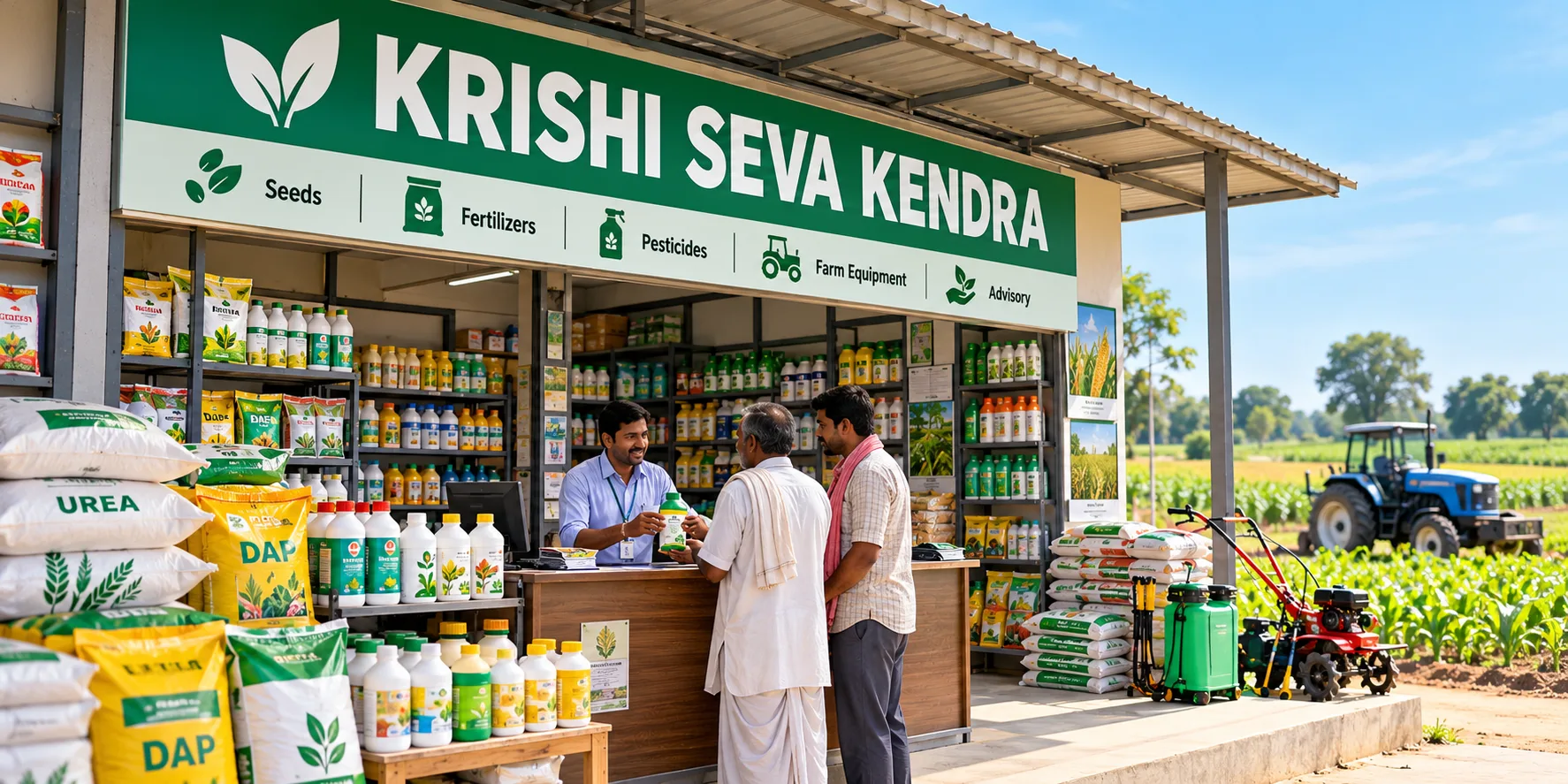
A Krishi Seva Kendra or an Agriculture Clinic and Agriculture Business Centre (ACABC) may require working capital lim for maintaining stocks of seeds, fertilizers, pesticides, agricultural equipment and other inputs.
Demand for several agricultural inputs is seasonal, so the entrepreneur may need to build inventory before the peak agricultural season.
Food Processing Businesses
Food-processing units generally need working capital for raw materials, packaging, labour, electricity, fuel and other operating expenses.
The requirement can increase when raw materials are purchased during a particular season but processed and sold over several months.
Seed Processing Businesses
Seed-processing businesses can have significant working-capital requirements because procurement, processing, packaging, storage and sales may occur at different points in time.
An entrepreneur may have to purchase seed when it is available and hold it until the processed product can be sold.
Oil Mills
Oil mills may require substantial funds for procuring oilseeds, especially when the entrepreneur intends to purchase larger quantities during the procurement season.
The working capital requirement will depend on procurement quantity, inventory period, processing capacity, sales cycle and payment terms.
Agricultural Trading Businesses
Agricultural trading businesses can also require significant working capital because the entrepreneur may need to purchase commodities before receiving payment from buyers.
The requirement can change significantly with commodity prices, inventory holding periods and market conditions.
How Long Will Your Money Remain Locked?
One of the most important questions when calculating working capital requirement is how long the money will remain committed to the business.
Suppose a business has recurring expenses of ₹5 lakh per month. It would be incorrect to assume that ₹5 lakh automatically represents the complete working capital requirement.
The entrepreneur should also consider how frequently raw materials are purchased, how long inventory remains in stock, how long production takes, when finished goods are sold and when customers actually make payment.
The entrepreneur should also determine whether the previous cycle’s money will return before the next procurement cycle begins.
If it does not, additional working capital may be required.
Seasonality and Working Capital Requirement
Seasonality is one of the biggest factors that agripreneurs should consider while calculating working capital.
Agricultural raw materials may be available in large quantities during harvest and become scarce later. Prices may also change considerably between procurement periods.
Suppose a processing unit normally purchases a crop at ₹30 per kg during the harvest season. If a crop failure reduces local availability, the entrepreneur may later have to purchase the same raw material from another region at ₹40 or ₹45 per kg.
The quantity required may remain unchanged, but the amount of cash required to procure it has increased substantially.
This creates a working-capital stretch.
Therefore, an entrepreneur whose business depends heavily on crops produced in a particular area should consider alternative suppliers, other procurement markets, inventory strategy and adequate liquidity while preparing the project.
A business plan should not be designed only for an ideal agricultural season. It should also consider what happens when crop production, prices or market conditions deviate from expectations.
What Happens When Crop Failure Affects Raw Material Supply?
A crop failure can create two problems at the same time: lower availability and higher procurement costs.
For an agriculture-processing business dependent on local farmers, this can be particularly challenging.
If the entrepreneur has already committed to production or customer orders, the business may have to purchase raw materials from another region at a higher price.
This additional requirement may not have been visible in the original project calculation.
Agripreneurs should therefore examine whether they can diversify their suppliers, procure from different geographical areas, maintain an appropriate inventory buffer or establish suitable arrangements with producers.
The right approach depends on the nature of the commodity and business, but the principle remains the same: working capital should be planned with realistic business risks in mind.
How to Calculate Working Capital Requirement
There is no single formula that works perfectly for every agriculture business.
A practical approach is to estimate the amount of money required to support the operating cycle.
Consider a food-processing unit with the following monthly expenses:
| Particular | Monthly Requirement |
|---|---|
| Raw material | ₹6,00,000 |
| Labour | ₹1,00,000 |
| Electricity and fuel | ₹75,000 |
| Packaging | ₹50,000 |
| Other operating expenses | ₹25,000 |
| Total | ₹8,50,000 |
If the business requires approximately two months of operating-cycle support, the initial estimate could be:
₹8.50 lakh × 2 months = ₹17 lakh
However, ₹17 lakh should not automatically be treated as the final bank-finance requirement.
The entrepreneur must also consider inventory, receivables, supplier credit, seasonal procurement, promoter contribution and other relevant current assets and liabilities.
The final requirement should reflect the actual operating cycle of the business.
Working Capital Is Not the Same as a Term Loan

Understanding the difference between a term loan and working capital finance is essential for every agripreneur.
A term loan is generally used to finance long-term or fixed assets such as eligible land-related expenditure, buildings, machinery, equipment or construction, depending on the specific lending product.
The loan is normally repaid through scheduled instalments over an agreed period.
Working capital finance serves a different purpose. It supports the short-term operating requirements of the business.
One common form of working capital finance is a Cash Credit limit (CC limit).
For example, suppose a bank sanctions a ₹50 lakh cash credit limit. The entrepreneur does not necessarily receive ₹50 lakh as a lump-sum amount for unrestricted use.
Instead, the facility allows the borrower to draw funds within the sanctioned limit and applicable conditions. Interest is generally calculated on the amount utilised, subject to the lender’s applicable terms and methodology.
This allows the entrepreneur to use financing according to the business’s working-capital requirement rather than borrowing the entire sanctioned amount at once.
The exact drawing-power conditions, interest calculation, renewal requirements, charges and other terms depend on the bank and the sanction conditions.
What Is a Cash Credit Limit?
A cash credit limit provides flexibility for managing short-term business requirements.
Suppose an entrepreneur has a sanctioned CC limit of ₹50 lakh. If the entrepreneur currently needs only ₹10 lakh, the entrepreneur may utilise the amount permitted under the applicable terms rather than necessarily using the entire ₹50 lakh.
If the working capital requirement later increases, additional funds may be utilised within the sanctioned conditions.
This is different from a term loan, where the loan amount is generally disbursed and repaid through a predetermined repayment structure.
A working capital requirement therefore needs to be understood as a financial tool for managing the operating cycle, not simply as extra money available to the entrepreneur through cc limit.
Working Capital Finance and Interest
Interest on working capital facility is generally linked to the amount utilised and the applicable interest rate and terms.
Therefore, a sanctioned limit and the amount actually utilised are not necessarily the same.
For example, if a ₹50 lakh CC limit (cash credit limit) is sanctioned but only ₹15 lakh is utilised, the applicable interest calculation will generally relate to the utilisation rather than treating the entire sanctioned limit as a normal term-loan disbursement.
The borrower must also service interest on working capital and comply with the conditions of the facility.
Working capital facilities may be subject to periodic review or renewal, depending on the product and lender’s policy.
What About Penal Charges?
Entrepreneurs should not assume that a particular penal interest percentage applies universally across banks.
The applicable charges depend on the lender, product and sanction terms. RBI’s current framework requires regulated entities to have a transparent policy for penal charges and states that such charges should not be levied in the form of additional penal interest or capitalised further as interest.
Therefore, borrowers should carefully read their sanction letter, loan agreement and applicable schedule of charges.
An entrepreneur should be particularly careful about exceeding sanctioned limits or failing to comply with conditions attached to the working-capital facility.
Promoter Contribution and Bank Finance
Another important concept for agripreneurs is promoter contribution.
Many entrepreneurs want the bank to finance the maximum possible portion of a project. However, lenders also assess how much the promoter is contributing to the project and how much financial risk is being taken by the entrepreneur.
The exact promoter margin varies according to the lender, loan product, project and applicable financing norms. Therefore, a figure such as 25% should not be treated as a universal requirement.
The broader principle is more important.
An entrepreneur should have a realistic amount of own contribution or margin and should not build the entire project around the assumption that the bank will finance everything.
A business owner who contributes their own capital also has a direct financial stake in the success of the project.
From a lender’s perspective, promoter contribution is one part of the overall credit assessment. The bank also examines the business model, cash flows, repayment capacity, project feasibility, risks and other relevant factors.
What Is Leverage in Business Finance?
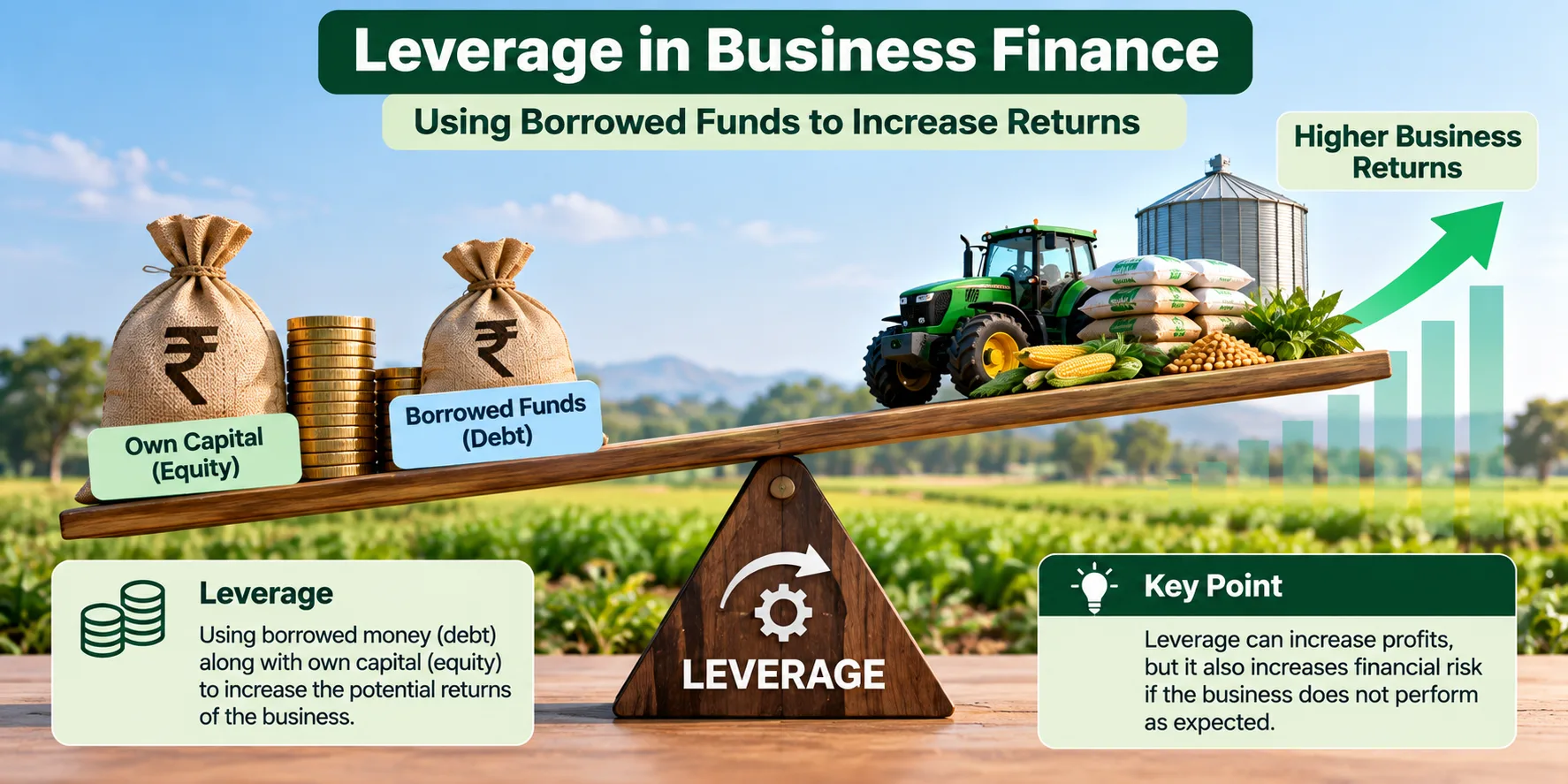
Leverage simply means using borrowed money to grow a business beyond what you could build using only your own money.
For example, suppose an entrepreneur contributes ₹25 lakh and obtains ₹75 lakh of eligible debt financing for a ₹1 crore project.
The entrepreneur is using debt to increase the scale of the business beyond what could be achieved using only personal capital.
This is leverage.
Leverage can help a business expand its productive capacity, but it also creates repayment obligations.
If the business performs well, debt can help the entrepreneur operate a larger asset base. If the business performs poorly, however, the debt obligation does not automatically disappear.
Therefore, the right question is not:
“How much can the bank finance?”
A better question is:
“How much debt can my business realistically support from its cash flows?”
Understanding this distinction can help an agripreneur avoid excessive financial pressure.
How Banks Assess Working Capital Requirements
A bank does not normally assess a working-capital request simply by looking at the amount requested by the borrower.
The lender may examine the nature of the business, projected turnover, operating cycle, inventory requirements, receivables, supplier credit, financial statements, past performance, promoter contribution, security and repayment capacity, along with other relevant factors.
The quality of the assumptions is therefore extremely important.
A project report stating that a business requires ₹30 lakh of working capital is much stronger when it explains why ₹30 lakh is required and how the amount was calculated.
The entrepreneur should be able to explain the procurement cycle, inventory period, production cycle, sales cycle and collection period.
Red Flags in Working Capital Calculations
Certain assumptions should immediately receive additional attention when preparing or reviewing a project.
Ignoring the Operating Cycle
An entrepreneur may calculate monthly expenses but fail to consider how long the money remains tied up in inventory and receivables.
Assuming Stable Raw-Material Prices
Agricultural commodity prices can change because of crop production, weather conditions, supply shortages and market conditions.
Using one fixed price without considering possible variation can make the working-capital estimate unrealistic.
Ignoring Crop or Supply Risk
A business dependent on one local crop or a small group of suppliers can face serious procurement problems if production falls.
Underestimating Inventory
An entrepreneur may assume that inventory will be sold immediately even though the actual business may require several weeks or months to sell the stock.
Ignoring Receivables
Sales do not always mean immediate cash.
If customers receive 30, 60 or 90 days of credit, the business must finance the gap.
Excessive Dependence on Borrowed Funds
A project that assumes very little promoter contribution may need to be examined carefully to determine whether the capital structure is realistic.
Ignoring Adverse Market Conditions
A project should be tested against reasonable changes in raw-material prices, sales volumes, procurement conditions and other important assumptions.
Working Capital and the DPR
A good DPR for an agriculture business should not simply mention a figure under the heading “Working Capital.”
It should explain how that figure was calculated.
An entrepreneur should be able to demonstrate the expected raw-material requirement, inventory holding period, production cycle, sales cycle, receivables, supplier credit and other operating expenses.
This makes the project report more transparent and allows the lender to understand the actual financing requirement.
A realistic working-capital calculation also helps the entrepreneur avoid borrowing too little or unnecessarily taking on excessive debt.
Profit Does Not Always Mean Cash Is Available
One of the most important concepts for a new agripreneur is the difference between profit and liquidity.
Suppose your business makes a sale worth ₹10 lakh. The sale may increase your revenue and contribute to profit, but if the customer will pay after 60 days, you cannot necessarily use that ₹10 lakh today.
During those 60 days, you may still need to pay wages, electricity, transport costs and purchase additional raw materials.
This is why a profitable business can still experience a cash-flow problem.
Profitability tells you whether the business can generate a surplus. Liquidity tells you whether the business has enough available cash to meet its obligations when they become due.
Both are important.
A Practical Working Capital Checklist for Agripreneurs
Before finalising your working capital requirement, ask yourself:
Raw materials: How much raw material do I need and when is it available?
Procurement: Will I need to purchase a large quantity during the harvest season?
Inventory: How long will raw materials and finished goods remain in stock?
Production: How much time and money are required before the product is ready for sale?
Sales: How quickly can the finished product be sold?
Receivables: When will customers actually pay?
Suppliers: Will suppliers provide any credit period?
Seasonality: What happens to my requirement during the peak and off-season?
Price risk: What happens if the raw-material price increases?
Crop risk: What happens if the crop fails or local availability falls?
Liquidity: Can I fund the business until money from the previous cycle returns?
Finance: How much should come from my own funds and how much financing is actually required?
Leverage: Can the business comfortably support the proposed debt?
These questions can reveal problems that a simple monthly-expense calculation may miss.
Final Takeaway
Working capital is the financial fuel that keeps an agriculture business moving.
Land, buildings, machinery and other fixed assets may establish the business, but working capital allows the entrepreneur to purchase inputs, maintain inventory, process goods and continue operations until sales generate cash.
For an agripreneur, the objective should not simply be to obtain the maximum possible bank finance.
The objective should be to arrange adequate and sustainable finance for the actual operating cycle of the business.
Remember that money invested in inventory or receivables may not be available for the next operating cycle. Agricultural businesses also face additional uncertainty because crop failures, seasonal shortages and price movements can suddenly increase procurement costs.
A strong working-capital plan therefore considers both the normal operating cycle and realistic adverse situations.
Finally, understand leverage before taking debt. Borrowing can help an entrepreneur build a larger business, but it also creates financial obligations. The right amount of debt is not necessarily the maximum amount a bank is willing to sanction. It is the amount that the business can realistically support through its cash flows.
Plan your working capital around the real business cycle, not just an optimistic spreadsheet.
Frequently Asked Questions
What is working capital requirement?
Working capital requirement is the amount of funds a business needs to support its day-to-day operations until the money invested in the operating cycle returns through sales and collections.
How is working capital requirement calculated?
A basic starting point is to estimate the funds required for inventory, receivables and other current operating assets and then consider available supplier credit and other current liabilities. The exact calculation depends on the business model and lender’s assessment method.
Which agriculture businesses require high working capital?
Food processing, seed processing, oil mills, agricultural trading and some Krishi Seva Kendra or ACABC businesses can require substantial working capital because they may involve inventory, seasonal procurement, processing periods and credit sales.
What is the difference between working capital and a term loan?
A term loan is generally used for long-term or fixed assets and is repaid through scheduled instalments. Working-capital finance is designed to support the short-term operating cycle of a business.
What is a cash credit limit?
A cash credit limit is a form of working-capital facility that allows an eligible borrower to utilise funds within a sanctioned limit and applicable conditions. Interest is generally linked to the amount utilised and the lender’s applicable terms.
Why is seasonality important in working capital?
Agricultural businesses may need to purchase large quantities of raw materials during harvest or procurement periods. The money may remain tied up in inventory until the product is processed and sold, increasing the working-capital requirement.
What is leverage in business finance?
Leverage refers to using borrowed funds along with the entrepreneur’s own capital to finance a business. It can increase the scale of operations but also increases financial obligations.
Can a profitable agriculture business face a working-capital shortage?
Yes. A business can be profitable but still face a liquidity shortage if money is tied up in inventory or receivables and is not available when the next operating cycle begins.
What should an agripreneur do if raw-material prices suddenly increase?
The entrepreneur should assess alternative suppliers and procurement markets, review inventory strategy, evaluate pricing and margins, and ensure that sufficient liquidity is available to manage the temporary increase in the working-capital requirement.
How much promoter contribution is required for bank finance?
There is no single universal percentage applicable to every agriculture business. The required promoter margin depends on the bank, lending product, project, borrower and applicable financing terms.
You can apply for working capital as well as term loan for various food processing businesses at PMFME-MOFPI