
India has made tremendous progress in agricultural production over the past few decades. However, inadequate storage infrastructure continues to be one of the biggest bottlenecks in improving farmer incomes.
Every year, many farmers are forced to sell immediately after harvest due to a lack of storage facilities. This often results in lower prices, avoidable losses, and reduced profitability.
Recognizing this challenge, the Government of India introduced the Agriculture Infrastructure Fund (AIF), a financing initiative that supports the development of post-harvest management infrastructure and community farming assets.
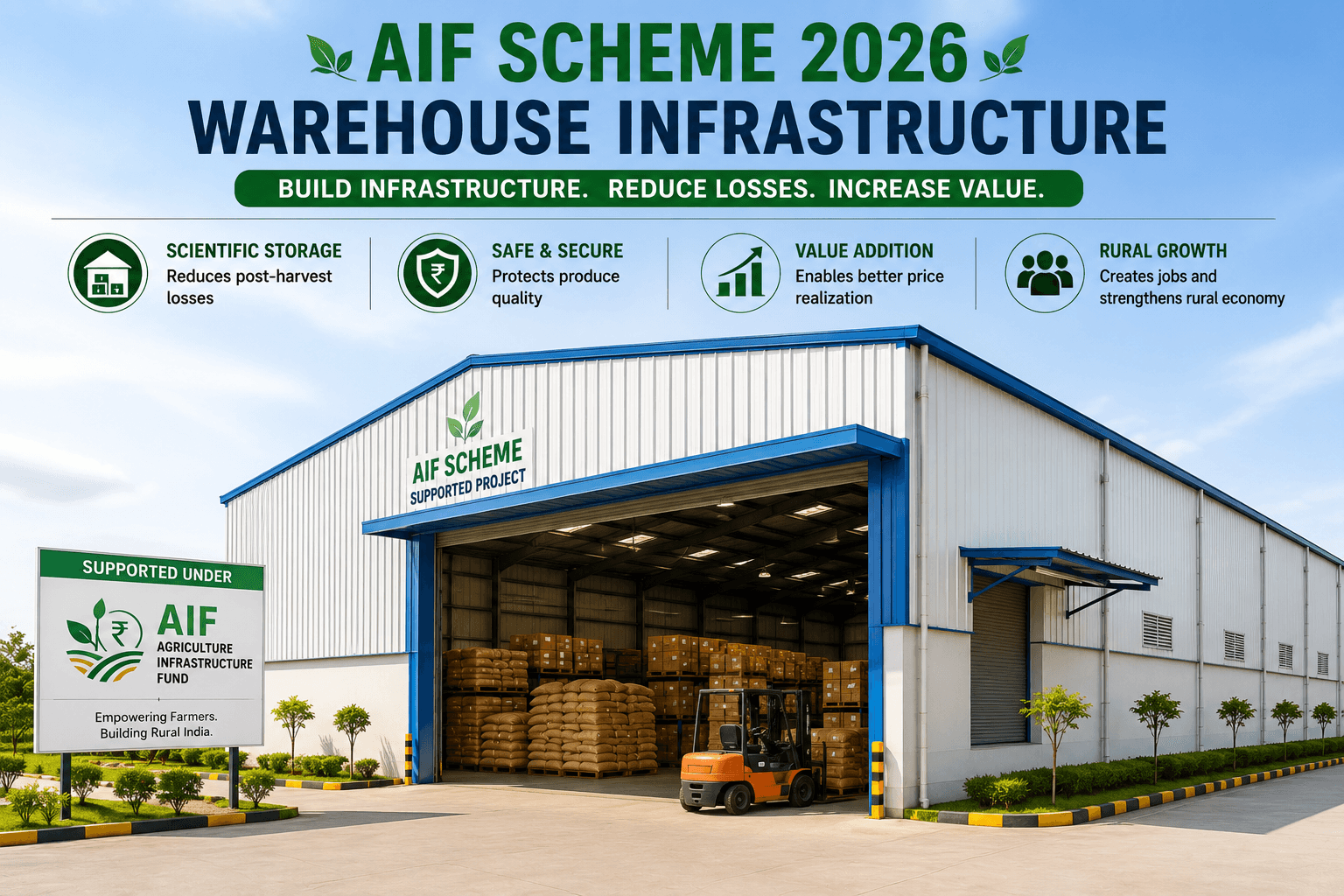
Among all AIF projects, warehouse Under AIF stand out because they solve a real agricultural problem while creating sustainable long-term businesses.
This guide explains every aspect of establishing a warehouse under AIF.
Why We Are Writing This Warehouse Under AIF Guide
At AgriTechKart, we continuously study agricultural financing schemes, project appraisal methodologies, agri-business models, and rural infrastructure development.
Warehouse Under AIF projects are among the most practical and scalable opportunities available under Agriculture Infrastructure Fund because they address one of India’s biggest agricultural inefficiencies: post-harvest management.
This guide combines agricultural knowledge, banking perspectives, infrastructure planning, and entrepreneurial insights to help readers make informed decisions.
Internal Link: Read our complete Agriculture Infrastructure Fund (AIF): Complete Guide 2026.
Why Warehouses Are Important for Indian Agriculture – Warehouse Under AIF
Warehouses strengthen the agricultural ecosystem in multiple ways.
Reducing Post-Harvest Losses
Scientific storage minimizes damage caused by:
- Moisture
- Pests
- Rodents
- Poor handling
Preventing Distress Selling
Farmers gain flexibility to sell produce at better prices.
Strengthening Supply Chains
Warehouses act as links between:
- Farmers
- FPOs
- Traders
- Processors
- Retailers
- Exporters
Improving Food Security
Proper storage ensures year-round availability of commodities.
Understanding Agriculture Infrastructure Fund (AIF)- Warehouse Under AIF
Agriculture Infrastructure Fund is a financing facility launched to support agricultural infrastructure development.
Its objectives are:
- Reduce post-harvest losses
- Improve value addition
- Strengthen supply chains
- Generate rural employment
- Increase farmer incomes
The scheme is implemented through multiple lending institutions.
Who Can Apply?
Eligible beneficiaries include:
- Individual farmers
- Farmer Producer Organizations (FPOs)
- PACS
- Cooperatives
- Agri entrepreneurs
- Agri startups
- SHGs
- JLGs
- Private entities
Types of Warehouses Eligible Under AIF
Rural Agricultural Warehouse Under AIF
Village-level storage facilities.
Scientific Warehouse
Modern warehouses equipped with:
- Ventilation systems
- Moisture control
- Pest management
Integrated Warehouse
Combined facilities offering:
- Sorting
- Grading
- Packaging
Smart Warehouse
Technology-enabled infrastructure with:
- IoT sensors
- Inventory software
- Real-time monitoring
How to Select the Right Location
Location determines profitability.
Consider:
Production Cluster
High crop-producing areas.
Connectivity
Easy access to roads.
Market Proximity
Near:
- Mandis
- Processing units
- Consumption centers
Utility Availability
- Electricity
- Water
- Internet
Future Expansion
Adequate space for growth.
Infrastructure Components
A warehouse Under AIF project may include:
Civil Infrastructure
- Main building
- Office room
- Security room
- Boundary wall
Internal Infrastructure
- Roads
- Drainage
- Concrete flooring
Equipment
- Weighbridge
- Pallets
- Moisture meters
Safety Systems
- CCTV
- Fire extinguishers
- Fire alarms
Digital Systems
- Inventory software
- Barcode systems
Warehouse Capacity Planning
Small Warehouse (500 MT)
Suitable for:
- Individual farmers
- Small FPOs
Medium Warehouse (1000 MT)
Suitable for:
- Entrepreneurs
- Established FPOs
Large Warehouse (3000 MT)
Suitable for:
- Cooperatives
- Large enterprises
Estimated Project Cost
| Capacity | Estimated Cost |
|---|---|
| 500 MT | ₹40 lakh – ₹70 lakh |
| 1000 MT | ₹80 lakh – ₹1.5 crore |
| 3000 MT | ₹2 crore – ₹5 crore |
Actual costs vary according to geography and specifications.
Financial Assistance Available Under AIF
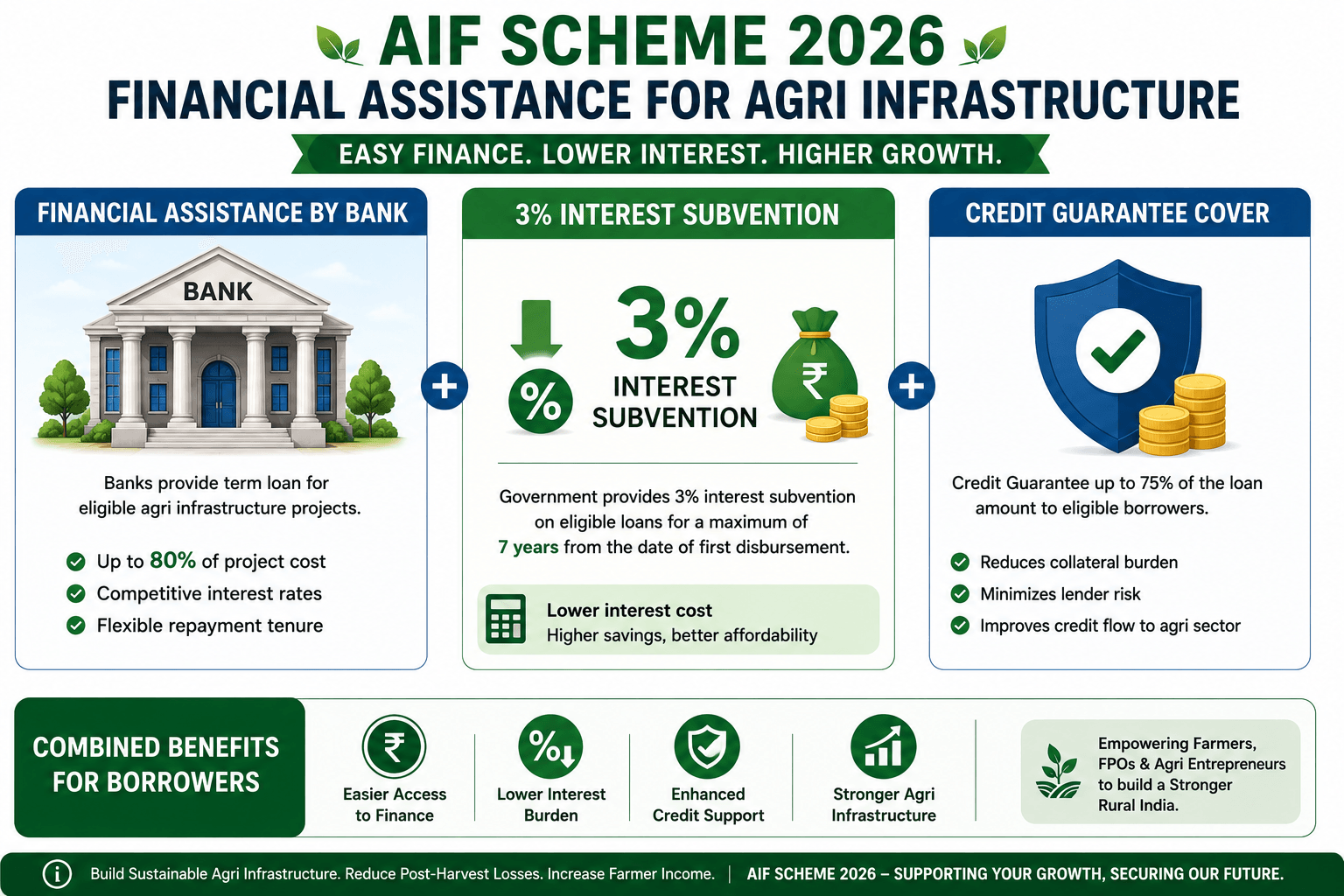
Interest Subvention
Eligible projects receive:
3% interest subvention.
Credit Guarantee Support
Available for eligible projects.
Loan Tenure
Typically:
7–10 years.
Moratorium may also be available.
Documents Required
Personal Documents
- Aadhaar
- PAN
- Address proof
Land Documents
- Ownership papers
- Lease agreement
Business Documents
- Registration certificates
Financial Documents
- Bank statements
Project Documents
- DPR
- Cost estimates
- Vendor quotations
How to Prepare a Strong DPR

A DPR should include:
Executive Summary
Project overview.
Market Analysis
Demand assessment.
Technical Feasibility
Infrastructure details.
Financial Analysis
Revenue projections.
Risk Analysis
Challenges and mitigation.
Repayment Plan
Loan servicing strategy.
Internal Link: How to Prepare DPR for AIF Projects.
How Banks Appraise Warehouse Under AIF Projects
Banks assess:
Promoter Profile
Experience and management ability.
Market Potential
Availability of commodities.
Location Viability
Accessibility and competition.
Financial Sustainability
Revenue generation ability.
Repayment Capacity
Cash flow sufficiency.
Compliance
Legal clearances.
Internal Link: How Banks Appraise AIF Projects.
AgriTechKart Banking Insights
Many projects fail not because the idea is weak but because planning is weak.
Common mistakes include:
Overestimating Occupancy
Banks become cautious when unrealistic assumptions are made.
Poor Location Selection
Building where there is insufficient crop movement.
Weak Market Linkages
No confirmed customers.
Generic DPRs
Copy-paste DPRs reduce credibility.
Underestimating Working Capital
Many promoters focus only on construction costs.
Revenue Streams
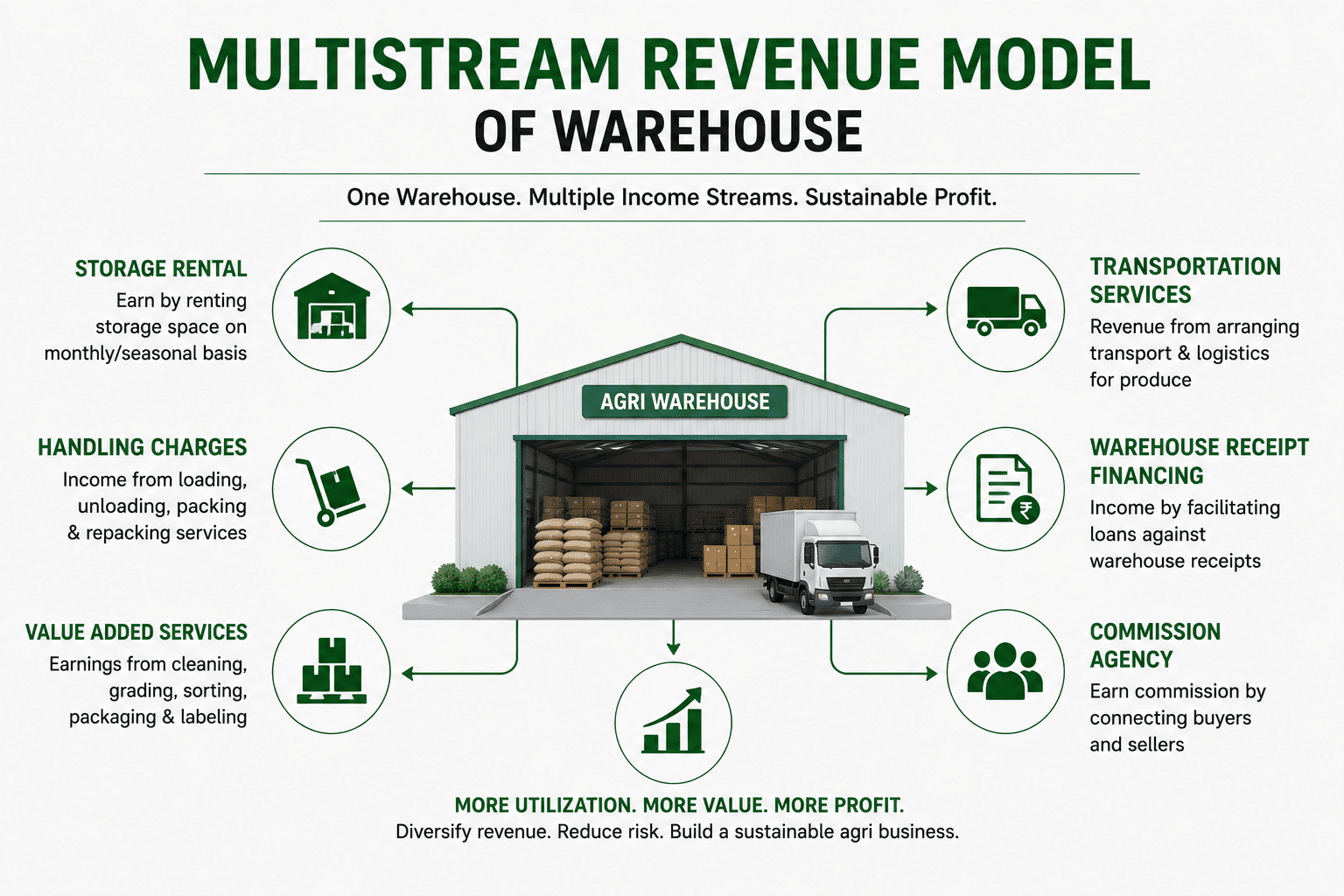
Warehouse Under AIF can generate income through:
Storage Charges
Primary income source.
Handling Charges
Loading and unloading fees.
Grading Services
Additional value-added services.
Packaging Services
Packaging income.
Logistics Services
Transportation support.
Rental Income
Leasing portions to businesses.
Profitability Example
Warehouse size:
1000 MT
Occupancy:
80%
Storage fee:
₹120 per MT/month
Monthly revenue:
800 × ₹120 = ₹96,000
Additional services can increase profitability.
Risks and Challenges
- Underutilization
- Seasonal demand
- Poor management
- Pest infestation
- Weak market research
Best Practices
- Build near production clusters.
- Partner with FPOs.
- Use technology.
- Diversify services.
- Build buyer networks.
- Maintain quality standards.
Internal Linking Strategy
Link this article to:
- Agriculture Infrastructure Fund (AIF): Complete Guide 2026
- How to Prepare DPR for AIF Projects
- How Banks Appraise AIF Projects
- Top 15 Profitable AIF Projects in India
- Market Research Framework for AIF Projects
- Backward and Forward Linkages in AIF Projects
- Geotagging in AIF Projects
Frequently Asked Questions
Where to apply for the scheme?
National Agriculture Infra Financing Facility This is the official website for the scheme, you can directly click and proceed to apply.
Is a warehouse eligible under AIF?
Yes.
Who can establish a ?
Farmers, FPOs, cooperatives, entrepreneurs, and eligible entities.
Is a DPR mandatory?
Yes, banks generally require one.
Is a warehouse profitable?
When properly planned and managed, yes.
Can additional services be integrated?
Yes.
Disclaimer
Scheme provisions may change over time. Readers should verify the latest guidelines before investing.
All costs mentioned are indicative and may vary.
About AgriTechKart
AgriTechKart is an agriculture knowledge platform focused on agri-financing, government schemes, agricultural technology, rural entrepreneurship, and sustainable infrastructure development.
Our mission is to simplify complex agricultural concepts into actionable knowledge for farmers, FPOs, agri entrepreneurs, students, and banking professionals.