
Introduction
Fertilizers are one of the biggest investments in modern farming. Whether you grow cereals, pulses, vegetables, fruits, or cash crops, applying the right nutrients at the right time is essential for achieving healthy crops and higher yields. However, using the right fertilizer alone is not enough. Knowing how to mix fertilizers correctly, and fertilizer compatibility is equally important.
Many farmers don’t know how to mix fertilizers correctly and mix two or more fertilizers to save time, labour, and application costs. While this is a common and useful practice, not every fertilizer can be safely mixed with another. Some fertilizer combinations work well together, while others may reduce nutrient availability, form hard lumps, damage application equipment, or even cause valuable nutrients to be lost before the crop can use them.
For example, a farmer may think that mixing all required fertilizers into one bag is convenient. But if the wrong fertilizers are mixed, part of the nitrogen may escape into the air, phosphorus may become unavailable to plants, or the mixture may absorb moisture and become difficult to spread. These mistakes not only waste money but also reduce crop productivity.
The good news is that these problems are easy to avoid with a basic understanding of fertilizer compatibility.
This guide has been prepared in simple language to help farmers, agricultural students, extension workers, and agri-professionals understand:
- What fertilizer compatibility means.
- Which fertilizers can be safely mixed.
- Which fertilizers should never be mixed.
- Why some combinations work while others do not.
- Practical precautions before mixing fertilizers.
- Simple field tips to improve fertilizer efficiency and reduce losses.
Instead of using complicated scientific terms, this guide focuses on practical knowledge that can be applied directly on the farm.
What Is Fertilizer Compatibility?
Fertilizer compatibility means whether two or more fertilizers can be mixed together safely without reducing their effectiveness or creating problems during storage, transportation, or application.
In simple words,
Compatible fertilizers can be mixed and applied together without causing significant nutrient loss or handling problems.
Incompatible fertilizers should not be mixed because they may react with each other, absorb moisture, become hard, lose nutrients, or reduce fertilizer efficiency.
Think of fertilizers like ingredients used in cooking. Some ingredients blend perfectly and improve the final dish, while others spoil the taste or texture when combined incorrectly. Fertilizers behave in a similar way. The right combination can improve nutrient management, while the wrong combination can reduce the benefit of even the best fertilizers.
Understanding fertilizer compatibility helps farmers use fertilizers more efficiently and get better value from every bag they purchase.
Why Is Fertilizer Compatibility Important?
Many farmers believe that if each fertilizer is good individually, then mixing them together will also be good. Unfortunately, this is not always true.
Incorrect fertilizer mixing can lead to:
- Loss of expensive nutrients.
- Reduced fertilizer efficiency.
- Poor crop growth.
- Blocked fertigation systems.
- Difficulty in field application.
- Wastage of money.
On the other hand, proper fertilizer compatibility offers several advantages.
1. Better Nutrient Availability
When compatible fertilizers are mixed correctly, nutrients remain available to the crop. This allows plants to absorb nitrogen, phosphorus, potassium, and other nutrients more efficiently.
2. Saves Labour and Time
Applying two compatible fertilizers in a single operation reduces labour, fuel consumption, and field traffic.
3. Reduces Fertilizer Losses
Certain fertilizer combinations can cause nitrogen to escape into the atmosphere or phosphorus to become unavailable. Avoiding incompatible mixtures helps prevent these losses.
4. Improves Fertilizer Efficiency
Every kilogram of fertilizer represents an investment. Correct mixing ensures that the nutrients reach the crop instead of being wasted.
5. Prevents Equipment Problems
Some incompatible fertilizer mixtures form sticky masses or insoluble particles that may clog seed drills, fertilizer applicators, or drip irrigation systems.
6. Makes Fertilizer Application Easier
Physically compatible fertilizers remain free-flowing and spread more uniformly across the field.
7. Protects the Environment
Efficient fertilizer use reduces nutrient losses to the air and water, helping minimize environmental pollution.
A Simple Example
Imagine two farmers growing the same crop.
Both purchase exactly the same fertilizers.
Farmer A
- Mixes only compatible fertilizers.
- Applies them immediately.
- Stores fertilizers properly.
Farmer B
- Mixes incompatible fertilizers.
- Stores the mixture for several days.
- Uses damp fertilizer.
Even though both farmers bought the same fertilizers, Farmer A is more likely to achieve better nutrient efficiency and crop performance because the fertilizers were handled correctly.
The difference lies not only in what fertilizer was used, but also how it was used.
Types of Fertilizer Compatibility
Fertilizer compatibility can be divided into three simple categories.
Understanding these categories makes it much easier to decide whether fertilizers should be mixed.
1. Physical Fertilizer Compatibility
Physical fertilizer compatibility refers to how fertilizers behave when they are mixed together.
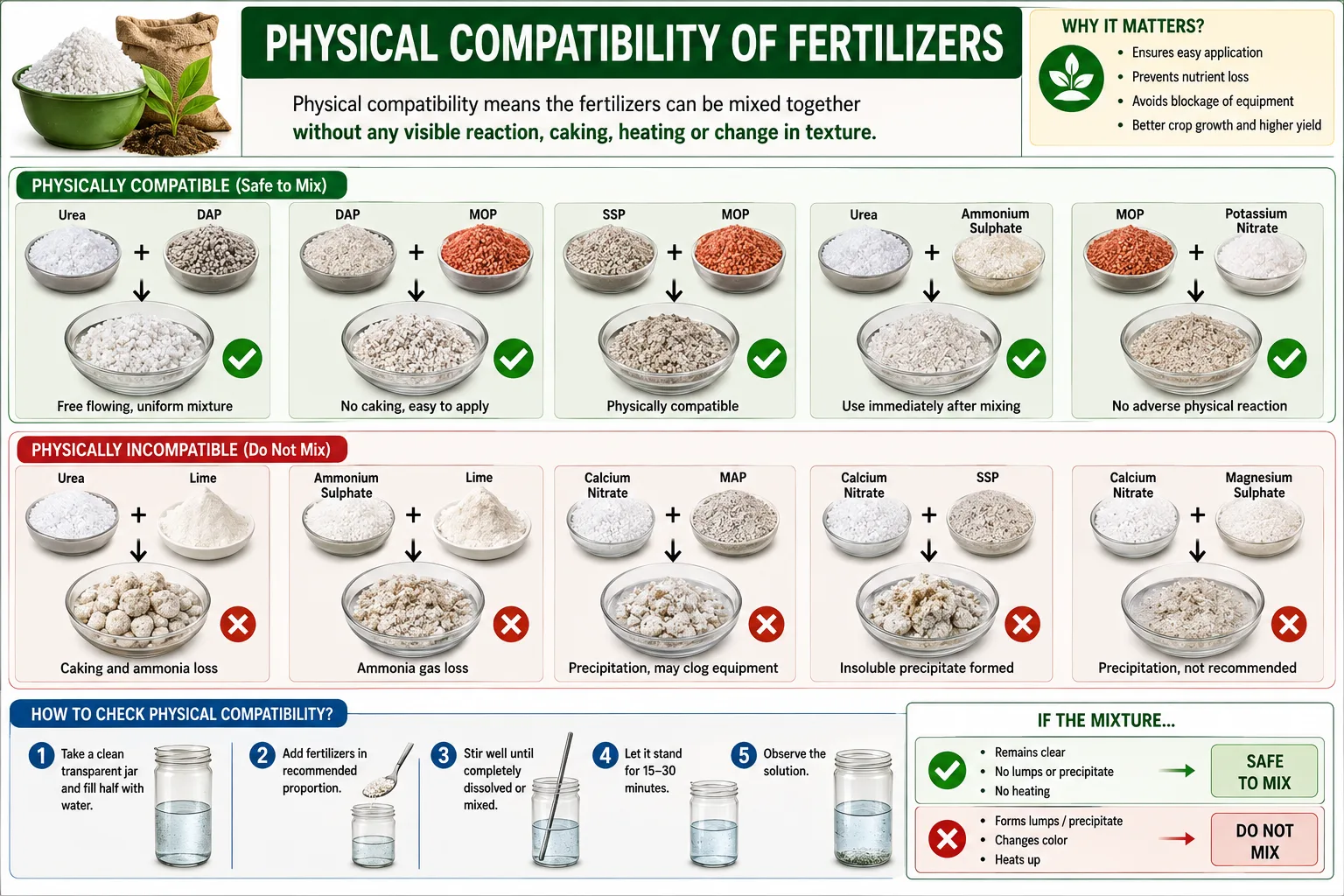
A physically compatible mixture remains:
- Free flowing
- Easy to spread
- Easy to store for a short period
- Uniform in appearance
Problems occur when fertilizers:
- Absorb moisture from the air.
- Form hard lumps.
- Become sticky.
- Separate into different layers.
- Produce excessive dust.
Example
Suppose you mix two fertilizers and leave them in an open shed during the rainy season.
After a few days, the mixture becomes one hard lump.
Although many nutrients may still be present, the fertilizer becomes difficult to apply uniformly.
This is an example of poor physical compatibility or poor storage management.
2. Chemical Fertilizer Compatibility
Chemical fertilizer compatibility refers to whether fertilizers react with each other after mixing.
Some chemical reactions may:
- Reduce nutrient availability.
- Cause nitrogen loss.
- Convert soluble nutrients into insoluble forms.
- Produce materials that clog irrigation systems.
Fortunately, these problems are easy to avoid once farmers know which combinations should never be mixed.
Example
Mixing ammonium-containing fertilizers with lime can cause valuable nitrogen to escape into the air as ammonia gas. As a result, the crop receives less nitrogen than intended.
Similarly, mixing phosphatic fertilizers with materials containing free lime may reduce phosphorus availability to plants.
These are among the most important compatibility rules every farmer should know.
3. Application Fertilizer Compatibility
Even if fertilizers are physically and chemically compatible, they should also be suitable for the method of application.
Different application methods include:
- Broadcasting
- Placement
- Band application
- Fertigation
- Foliar spraying
For example, a fertilizer combination that is suitable for broadcasting may not be suitable for drip irrigation because it could form deposits inside irrigation pipes.
Therefore, always consider how the fertilizer will be applied before deciding to mix it.
Factors That Affect Fertilizer Compatibility
Fertilizer Compatibility does not depend only on the fertilizers themselves. Several external factors also play an important role.
Moisture
Moisture is one of the biggest enemies of fertilizer storage.
Some fertilizers absorb water from the air very quickly.
If these fertilizers are mixed and stored under humid conditions, they may become sticky and difficult to spread.
Storage Time
Even compatible fertilizers should ideally be mixed shortly before application.
The longer fertilizers remain mixed, the greater the chance of:
- Moisture absorption
- Hardening
- Nutrient loss
- Reduced spreading quality
As a general rule, mix today and apply today whenever possible.
Temperature
High temperatures can increase moisture problems and may speed up certain chemical reactions.
Store fertilizers in a cool, dry, and well-ventilated place.
Fertilizer Quality
Poor-quality or damaged fertilizers may already contain excess moisture or broken granules, making them more difficult to mix properly.
Always purchase fertilizers from authorized dealers and inspect the bags before buying.
Water Quality
When fertilizers are dissolved for drip irrigation or foliar spraying, water quality becomes extremely important.
Hard water, high pH, or excessive bicarbonates can reduce fertilizer solubility and cause deposits in irrigation equipment.
A dedicated section later in this guide explains water quality and fertigation compatibility in detail.
Benefits of Understanding Fertilizer Compatibility
Learning about fertilizer compatibility is not just about avoiding mistakes—it also helps improve overall farm management.
Farmers who understand fertilizer compatibility can:
- Use fertilizers more efficiently.
- Reduce unnecessary expenses.
- Improve nutrient use efficiency.
- Avoid costly application errors.
- Protect irrigation equipment.
- Save labour.
- Increase crop productivity.
- Make better fertilizer purchasing decisions.
Even small improvements in fertilizer management can have a noticeable impact on crop performance and profitability over time.
Myth vs Fact
Myth
“All fertilizers can be mixed together because they all provide plant nutrients.”
Fact
Different fertilizers have different chemical properties. While many combinations are perfectly safe, some mixtures can reduce nutrient availability, absorb moisture, or cause handling problems. Knowing the difference helps farmers avoid unnecessary losses.
Farmer Tip
If you are not sure whether two fertilizers are compatible, do not guess. Check the fertilizer compatibility chart, perform a simple jar test (explained later in this guide), or seek advice from your local agricultural extension officer or fertilizer manufacturer. Spending a few minutes confirming fertilizer compatibility can save both fertilizer and money.
we learned what fertilizer compatibility means and why it is important. Now it’s time to answer the question every farmer asks:
“Can I mix these two fertilizers together?”
The answer depends on the fertilizers involved, how they are applied, and whether they are mixed for immediate use or long-term storage.
Before looking at the fertilizer compatibility chart, remember one important principle:
Even if two fertilizers are compatible, it is always better to mix them just before application rather than storing the mixture for several days.
This simple habit helps maintain fertilizer quality and reduces the chances of moisture absorption and caking.
Understanding the Compatibility Chart
The chart below uses three simple symbols.
| Symbol | Meaning |
|---|---|
| ✅ | Can generally be mixed and applied immediately. |
| ⚠️ | Can be mixed only with precautions. Avoid long-term storage or seek technical advice for special situations. |
| ❌ | Do not mix. Apply separately. |
Note: The chart is intended for common field application of granular fertilizers. Water-soluble fertilizers used in fertigation are discussed later in this guide.
Fertilizer Compatibility Chart for Common Granular Fertilizers
| Fertilizer | Urea | DAP | SSP | MOP | Ammonium Sulphate | Lime |
| Urea | ✅ | ✅ | ⚠️ | ✅ | ⚠️ | ❌ |
| DAP | ✅ | ✅ | ⚠️ | ✅ | ✅ | ❌ |
| SSP | ⚠️ | ⚠️ | ✅ | ✅ | ✅ | ❌ |
| MOP | ✅ | ✅ | ✅ | ✅ | ✅ | ⚠️ |
| Ammonium Sulphate | ⚠️ | ✅ | ✅ | ✅ | ✅ | ❌ |
| Lime | ❌ | ❌ | ❌ | ⚠️ | ❌ | ✅ |
Important: This chart provides general guidance for field use. Recommendations may vary depending on fertilizer grade, soil type, and local agricultural university advisories. When in doubt, follow your state agricultural extension recommendations.
Golden Rule 1
Mix Today, Apply Today
Many fertilizer problems occur not because of incorrect mixing, but because the mixed fertilizers are stored for several days.
Even compatible mixtures may:
- absorb moisture,
- become hard,
- lose free-flowing properties, or
- spread unevenly.
Best Practice
✔ Mix fertilizers only when you are ready to apply them.
Avoid preparing fertilizer mixtures several days in advance unless specifically recommended.
Golden Rule 2
Never Mix Highly Hygroscopic Fertilizers for Storage
Some fertilizers absorb moisture very quickly from the surrounding air. These are called hygroscopic fertilizers.
Common examples include:
- Urea
- Ammonium nitrate
- Ammonium sulphate
- Ammonium sulphate nitrate
When these fertilizers are mixed and stored, especially during humid or rainy weather, they may:
- become wet,
- form hard lumps,
- lose their free-flowing nature,
- block fertilizer drills,
- become difficult to spread uniformly.
Farmer Tip
If these fertilizers need to be used together, mix only the quantity required for immediate application.
Never prepare and store large quantities for future use.
Golden Rule 3
Never Mix Ammonium Fertilizers with Lime
This is one of the most important fertilizer compatibility rules.
Avoid mixing fertilizers containing ammonium (NH₄⁺) with alkaline materials such as:
- Lime
- Quick lime
- Slaked lime
- Basic slag
Examples of ammonium fertilizers include:
- Ammonium sulphate
- Ammonium nitrate
- Ammonium sulphate nitrate
Although urea does not contain ammonium in the bag, after application it rapidly converts to ammonium in the soil. Mixing urea with lime before application can also lead to nitrogen loss.
Why?
When ammonium fertilizers come into contact with alkaline materials, part of the nitrogen escapes into the air as ammonia gas.
This means:
❌ Less nitrogen reaches the crop.
❌ Fertilizer money is wasted.
Farmer-Friendly Example
Imagine buying a 50 kg fertilizer bag but losing part of its nitrogen before it even reaches your crop.
That is exactly what can happen when ammonium fertilizers are mixed with lime.
Best Practice
Apply lime separately.
If both lime and nitrogen fertilizers are required, apply them at different times according to local recommendations.
Golden Rule 4
Never Mix Water-Soluble Phosphatic Fertilizers with Materials Containing Free Lime
Water-soluble phosphatic fertilizers include products such as:
- Single Super Phosphate (SSP)
- Triple Super Phosphate (TSP)
- Mono Ammonium Phosphate (MAP)
- Mono Potassium Phosphate (MKP)
These should not be mixed with materials containing free lime.
Why?
The phosphorus changes into forms that plants cannot absorb easily.
Although the phosphorus is still present, it becomes much less useful to the crop.
In simple words,
The fertilizer is there, but the plant cannot use it efficiently.
Golden Rule 5
Be Careful with Chloride-Containing Fertilizers
Some fertilizers contain chloride salts.
When stored improperly under humid conditions, these fertilizers may:
- damage gunny bags,
- corrode metal fertilizer drills,
- increase rusting of storage equipment.
Best Practice
Store fertilizer bags:
- on wooden pallets,
- away from moisture,
- in well-ventilated stores,
- protected from rain.
Inspect fertilizer drills and spreaders regularly for rust.
Golden Rule 6
Do Not Mix Wet Fertilizers
Never mix fertilizers that already contain moisture.
Wet fertilizers:
- stick together,
- become difficult to spread,
- block equipment,
- may lose quality during storage.
If fertilizer bags feel damp or contain hard lumps, inspect them carefully before use.
Golden Rule 7
Do Not Assume Similar-Looking Fertilizers Are Compatible
Many fertilizer granules look almost identical.
Never decide fertilizer compatibility based on colour or size.
Always identify the fertilizer by:
- bag label,
- nutrient analysis,
- manufacturer information.
When uncertain, consult the fertilizer compatibility chart.
Golden Rule 8
Keep Fertilizers Separate from Pesticides During Storage
Although some fertilizers and pesticides may be compatible for certain spray applications, they should not be stored together.
Separate storage helps avoid:
- accidental contamination,
- chemical damage,
- moisture problems,
- safety risks.
Golden Rule 9
Check Fertilizer Bags Before Purchase
Buying good-quality fertilizer is the first step toward successful mixing.
Avoid bags that show:
- excessive moisture,
- leakage,
- broken stitching,
- hardened fertilizer,
- damaged packaging.
Golden Rule 10
Read the Manufacturer’s Instructions
Modern specialty fertilizers sometimes have specific mixing recommendations.
Always read the label before mixing unfamiliar fertilizers.
Common Fertilizer Combinations Farmers Ask About
Can Urea and DAP Be Mixed?
✅ Yes.
They are commonly mixed for immediate field application.
However, avoid storing the mixture for long periods.
Can DAP and MOP Be Mixed?
✅ Yes.
This is one of the most common fertilizer mixtures used in agriculture.
Can SSP and MOP Be Mixed?
✅ Generally yes.
Apply soon after mixing for best results.
Can Urea and Lime Be Mixed?
❌ No.
Nitrogen loss may occur.
Apply separately.
Can Ammonium Sulphate and Lime Be Mixed?
❌ No.
Nitrogen may escape into the atmosphere.
Can Lime and DAP Be Mixed?
❌ No.
Apply separately.
Farmer’s Quick Decision Table
| Situation | What Should You Do? |
| Need nitrogen and phosphorus together | Mix compatible fertilizers like urea and DAP only for immediate use. |
| Applying lime | Apply lime separately from ammonium or urea fertilizers. |
| Fertilizer mixture will be stored for several days | Avoid mixing. Prepare fresh mixtures before application. |
| Fertilizer feels wet | Dry if appropriate under recommended conditions or replace if quality is compromised. Do not mix wet fertilizers. |
| Unsure about fertilizer compatibility | Check the fertilizer compatibility chart, perform a jar test where applicable, or consult an agricultural expert. |
Common Mistakes Farmers Should Avoid
Many fertilizer losses happen because of small mistakes.
Avoid these common errors:
❌ Mixing fertilizers several days before sowing.
❌ Storing fertilizer mixtures during the rainy season.
❌ Leaving fertilizer bags open overnight.
❌ Placing fertilizer bags directly on the floor.
❌ Mixing fertilizers simply because neighbours do so.
❌ Ignoring the manufacturer’s instructions.
❌ Using wet or damaged fertilizers.
❌ Assuming every fertilizer combination is safe.
Remember,
A few minutes spent checking fertilizer compatibility can save both fertilizer and money.
Did You Know?
- A fertilizer that has formed small lumps is not always useless. If the lumps are caused only by moisture and the fertilizer has not chemically deteriorated, careful crushing may restore its usability. However, heavily caked or contaminated fertilizer should not be used without proper guidance.
- Most fertilizer compatibility problems can be prevented by correct storage and mixing only what is needed for immediate application.
- Fertilizer compatibility is important not only for crop yield but also for protecting seed drills, broadcasters, and other application equipment.
AgriTechKart Practical Tip
Before preparing a large fertilizer mixture for your entire field, mix a small quantity in a clean bucket and observe it for a few minutes.
If the mixture:
- remains dry,
- flows freely,
- shows no unusual heating,
- develops no strong ammonia smell, and
- does not become sticky,
it is generally a good sign from a physical handling perspective. However, this simple observation does not replace fertilizer compatibility recommendations. Always follow established guidance for known incompatible fertilizer combinations.
Water-Soluble Fertilizer Compatibility, Fertigation, Foliar Sprays, and the Jar Test
In recent years, more farmers have started using drip irrigation, sprinkler irrigation, and foliar sprays to improve fertilizer efficiency and save water. These methods allow nutrients to reach plants quickly and reduce fertilizer wastage.
However, there is one important difference between applying granular fertilizers in the field and dissolving fertilizers in water.
When fertilizers are mixed in water, some combinations can form tiny solid particles that are not visible at first. These particles may block drip emitters, clog filters, reduce water flow, and prevent nutrients from reaching the crop.
The good news is that these problems can be easily avoided by understanding a few simple fertilizer compatibility rules.
What Are Water-Soluble Fertilizers?
Water-soluble fertilizers dissolve completely in water and are commonly used in:
- Drip irrigation (fertigation)
- Sprinkler irrigation
- Foliar spraying
- Nursery production
- Protected cultivation (polyhouse and greenhouse)
Some commonly used water-soluble fertilizers include:
- 19:19:19
- 20:20:20
- 13:40:13
- 12:61:00 (MAP)
- 00:52:34 (MKP)
- Potassium nitrate (13:0:45)
- Calcium nitrate
- Magnesium sulphate
- Potassium sulphate (water-soluble grade)
The Most Important Rule in Fertigation
Never mix calcium fertilizers with phosphate or sulphate fertilizers in the same stock solution.
If you remember only one rule from this section, let it be this one.
Why Is Calcium Different?
Calcium is an important plant nutrient, but it reacts easily with phosphorus and sulphur in concentrated fertilizer solutions.
When calcium nitrate is mixed directly with phosphate or sulphate fertilizers, insoluble particles may form.
These particles can:
- block drip emitters,
- clog filters,
- reduce fertilizer flow,
- waste nutrients,
- increase maintenance costs.
Instead of reaching the crop, the nutrients remain trapped inside the irrigation system.
Fertigation Tank A and Tank B
Most commercial fertigation systems use two separate fertilizer tanks.
This simple arrangement prevents unwanted chemical reactions.
Tank A
Usually contains calcium fertilizers.
Examples:
- Calcium nitrate
Tank B
Contains fertilizers such as:
- MAP
- MKP
- Potassium nitrate
- Magnesium sulphate
- NPK water-soluble fertilizers
Keeping these fertilizers in separate tanks prevents precipitation and ensures smooth operation of the irrigation system.
Farmer Tip
If your fertigation system has only one tank, inject calcium fertilizers separately from phosphate- and sulphate-containing fertilizers. Flush the irrigation system with clean water before changing fertilizer solutions.
Water-Soluble Fertilizer Compatibility Chart
| Fertilizer | Calcium Nitrate | MAP | MKP | Potassium Nitrate | Magnesium Sulphate |
|---|---|---|---|---|---|
| Calcium Nitrate | ✅ | ❌ | ❌ | ✅ | ❌ |
| MAP (12:61:00) | ❌ | ✅ | ✅ | ✅ | ⚠️* |
| MKP (00:52:34) | ❌ | ✅ | ✅ | ✅ | ⚠️* |
| Potassium Nitrate | ✅ | ✅ | ✅ | ✅ | ✅ |
| Magnesium Sulphate | ❌ | ⚠️* | ⚠️* | ✅ | ✅ |
⚠️*Note: Fertilizer Compatibility may depend on concentration, water quality, and the order of mixing. Always follow product recommendations and perform a jar test before preparing large batches.
Mixing Order Matters
Even compatible fertilizers should be mixed correctly.
A simple mixing sequence is:
- Fill the tank halfway with clean water.
- Dissolve one fertilizer completely.
- Add the next fertilizer slowly while stirring.
- Fill the remaining water.
- Mix thoroughly before application.
Never add dry fertilizers together first and then pour water over them.
Use Clean Water
Water quality has a major effect on fertilizer performance.
Water that contains too much:
- calcium,
- magnesium,
- bicarbonates,
- iron,
- suspended soil,
may reduce fertilizer efficiency.
Whenever possible:
- use clean water,
- filter irrigation water,
- clean filters regularly.
Hard Water Can Cause Problems
Some farmers prepare fertilizer solutions using hard borewell water.
Hard water contains high levels of calcium and magnesium.
This can reduce fertilizer solubility and increase the chance of deposits inside irrigation pipes.
If hard water is suspected:
- test the water,
- clean the irrigation system regularly,
- consult local agricultural experts if problems continue.
Fertigation Best Practices
✔ Filter irrigation water before adding fertilizers.
✔ Dissolve fertilizers completely.
✔ Never exceed recommended concentrations.
✔ Flush the irrigation system with clean water after fertigation.
✔ Keep fertilizer tanks clean.
✔ Store water-soluble fertilizers in airtight containers.
Foliar Fertilizer Compatibility
Foliar spraying is an effective way to correct nutrient deficiencies quickly.
However, mixing too many products in one spray tank increases the risk of incompatibility.
Whenever possible:
- keep spray mixtures simple,
- avoid unnecessary combinations,
- follow label recommendations.
Can Fertilizers Be Mixed with Pesticides?
Sometimes yes.
Sometimes no.
The answer depends on:
- fertilizer type,
- pesticide formulation,
- water quality,
- crop,
- concentration.
Because there are thousands of pesticide formulations, no single fertilizer compatibility chart covers every situation.
Therefore,
Always perform a jar test before preparing a large spray tank.
Also follow label instructions from both products.
Micronutrient Compatibility
Micronutrients are required in small quantities but are essential for healthy crop growth.
Below are general fertilizer compatibility guidelines.
| Micronutrient | General Fertilizer Compatibility |
| Zinc sulphate | Usually compatible with many fertilizers but avoid prolonged storage after mixing. |
| Boron | Generally compatible. |
| Chelated micronutrients | Usually compatible with most water-soluble fertilizers. |
| Iron | Follow product recommendations because compatibility depends on formulation. |
| Copper | Use caution when mixing with other products. |
| Manganese | Usually compatible under recommended conditions. |
Always read the manufacturer’s instructions because different formulations may behave differently.
Organic Products and Fertilizer Mixing
Many farmers now use:
- Humic acid
- Fulvic acid
- Seaweed extract
- Amino acids
- Organic biostimulants
These products may improve crop performance when used correctly, but fertilizer compatibility varies between manufacturers.
Before mixing:
- read the label,
- perform a jar test,
- avoid unnecessary combinations.
Biofertilizers Need Special Care
Biofertilizers contain living microorganisms.
Examples include:
- Rhizobium
- Azotobacter
- Azospirillum
- Phosphate Solubilizing Bacteria (PSB)
- Potash Mobilizing Bacteria (KMB/KSB)
- Mycorrhiza
Because these products contain beneficial living organisms, avoid mixing them directly with strong chemical fertilizers unless the manufacturer specifically recommends it.
Apply biofertilizers according to the product instructions to maintain their effectiveness.
The Simple Jar Test Every Farmer Should Know
If you are unsure whether two fertilizers or a fertilizer and a pesticide can be mixed safely, perform a jar test.
It takes only a few minutes and can prevent costly mistakes.
What You Need
- A clean, transparent glass or plastic jar.
- Clean water.
- The products you plan to mix.
- A spoon or stirrer.
Step 1
Fill the jar halfway with the same water that will be used for spraying or fertigation.
Step 2
Add the products in approximately the same proportion as planned for the field.
Step 3
Stir gently until dissolved.
Step 4
Leave the mixture undisturbed for 15–30 minutes.
Step 5
Observe carefully.
If you notice:
- solid particles,
- flakes,
- thick sediment,
- unusual heating,
- strong ammonia smell,
- separation into layers,
- gel formation,
do not prepare a large batch until fertilizer compatibility has been confirmed.
If the mixture remains uniform and stable, it is generally a good sign. However, the jar test does not replace manufacturer instructions or known fertilizer compatibility recommendations.
Frequently Asked Farmer Questions
Can I dissolve all fertilizers together in one tank?
No.
Some fertilizers react with each other and form insoluble particles.
Why do drip emitters become blocked?
One common reason is mixing incompatible fertilizers, especially calcium with phosphate or sulphate fertilizers.
Can I use muddy pond water for fertigation?
It is not recommended.
Use clean, filtered water whenever possible.
Why should I flush the irrigation system after fertigation?
Flushing removes fertilizer residues and helps prevent deposits from forming inside pipes and emitters.
AgriTechKart Field Tip
Good fertilizer management is not about using more fertilizer.
It is about making sure that every kilogram you purchase reaches the crop in the most effective form.
Simple practices such as using clean water, checking fertilizer compatibility, performing a jar test, and flushing irrigation systems can improve fertilizer efficiency without increasing fertilizer costs.
Congratulations! If you’ve read this far, you now understand the basic principles of fertilizer compatibility. In this final part, we’ll focus on practical farm management—how to store fertilizers safely, avoid common mistakes, apply fertilizers wisely, and become a better observer in your own field.
Remember:
The best fertilizer is not the one that costs the most—it is the one that reaches the crop in the right form, at the right time, and in the right amount.
Safe Fertilizer Storage Practices
Even the best-quality fertilizer can lose its free-flowing nature if it is stored improperly.
Follow these simple precautions to keep fertilizers in good condition.
Store in a Dry Place
Moisture is the biggest enemy of fertilizers.
Always store fertilizer bags:
- Inside a covered building.
- Away from rainwater.
- Away from leaking roofs.
- Away from damp walls.
Never Place Bags Directly on the Floor
Concrete floors can absorb and release moisture.
Always place fertilizer bags on:
- Wooden pallets
- Plastic sheets
- Raised platforms
This simple practice helps reduce moisture absorption.
Keep Bags Properly Covered
Once a fertilizer bag is opened:
- Close it tightly.
- Cover it with plastic if it will not be used immediately.
- Avoid leaving bags open overnight.
Separate Different Fertilizers
Store different fertilizers in separate stacks.
Clearly label each stack to avoid accidental mixing.
Keep Fertilizers Away from Pesticides
Although fertilizers and pesticides may be applied to the same crop, they should not be stored together.
Separate storage reduces the risk of contamination and accidental misuse.
Protect Fertilizers from Children and Animals
Store fertilizers in a secure location that is not accessible to children, livestock, or pets.
Transportation Precautions
Many fertilizer losses occur during transportation.
Always:
✔ Cover fertilizer bags while transporting.
✔ Avoid transporting damaged bags.
✔ Prevent bags from getting wet.
✔ Handle bags carefully to reduce breakage.
✔ Do not place heavy objects on top of fertilizer bags.
Weather Precautions
Weather conditions play an important role in fertilizer management.
Before Heavy Rain
Avoid applying fertilizers just before heavy rainfall.
Heavy rain may wash nutrients away before crops can absorb them.
During Rain
Do not mix or store fertilizers in open areas during rainy weather.
During Strong Winds
Avoid broadcasting fertilizers on windy days because nutrients may not be distributed evenly.
During Very Hot Weather
Store fertilizers under shade whenever possible.
Excessive heat may increase moisture-related problems inside storage structures.
Crop-Wise Fertilizer Management Tips
The following recommendations are general guidelines. Always follow the nutrient recommendations issued by your State Agricultural University, ICAR institute, or local agricultural department for your crop and soil conditions.
Rice
- Split nitrogen application instead of applying all at once.
- Avoid mixing incompatible fertilizers.
- Apply phosphorus according to local recommendations, often as a basal application.
Wheat
- Use balanced fertilization.
- Split nitrogen application improves efficiency.
- Apply fertilizers at the recommended growth stages.
Maize
- Place fertilizers close to the root zone but avoid direct seed contact unless specifically recommended.
- Maintain balanced nutrition throughout crop growth.
Soybean
- Pay attention to phosphorus nutrition.
- Seed treatment with recommended biofertilizers can improve nodulation where appropriate.
- Avoid unnecessary nitrogen application unless advised for local conditions.
Cotton
- Apply fertilizers in split doses according to crop stage.
- Balanced nutrition helps support healthy growth and boll development.
Sugarcane
- Split fertilizer applications improve nutrient use.
- Fertigation can be effective where drip irrigation is available.
- Flush the irrigation system after fertigation.
Fruits and Vegetables
- Water-soluble fertilizers can provide efficient nutrient delivery through drip systems.
- Monitor irrigation equipment regularly for clogging.
- Follow crop-specific nutrient schedules.
Common Mistakes Farmers Should Never Make
Even experienced farmers sometimes make avoidable mistakes.
Try to avoid these:
❌ Mixing fertilizers without checking fertilizer compatibility.
❌ Storing mixed fertilizers for several weeks.
❌ Leaving fertilizer bags open.
❌ Using damaged or wet fertilizers.
❌ Applying fertilizers before heavy rainfall.
❌ Ignoring soil test recommendations.
❌ Believing that more fertilizer always means more yield.
❌ Mixing products simply because they are available.
Remember:
Balanced fertilization is always better than excessive fertilization.
Ten Golden Rules for Safe Fertilizer Mixing
Let’s summarize the most important lessons from this guide.
1.Know your fertilizers before mixing them.
2.Use the fertilizer compatibility chart.
3.Mix only the quantity needed for immediate application.
4.Never mix ammonium fertilizers with lime or other strongly alkaline materials.
5.Keep calcium fertilizers separate from phosphate and sulphate fertilizers during fertigation.
6.Store fertilizers in a cool and dry place.
7.Never use wet fertilizers.
8.Perform a jar test whenever compatibility is uncertain.
9.Read product labels before mixing unfamiliar fertilizers.
10.When in doubt, seek advice from agricultural experts or extension officers.
AgriTechKart Farm Research Challenge
Become a Research Farmer!
Every successful farmer is also an observer.
You do not need an expensive laboratory to learn something new about your farm. Careful observation and record-keeping can help you understand what works best under your own soil and weather conditions.
That is why AgriTechKart is launching the Farm Research Challenge.
Your Mission
Select two small plots in the same field with similar soil conditions.
Each plot can be about 10 × 10 feet (3 × 3 metres) or any small size that is easy to manage.
Follow these rules:
- Use the same crop variety in both plots.
- Apply the same total amount of fertilizer recommended for your crop.
- Keep irrigation, weed control, and pest management the same in both plots.
- Do not try unsafe or incompatible fertilizer mixtures. Follow all safety recommendations in this guide.
Now compare a simple management practice that is already recommended for your crop.
For example:
- Plot A: Apply compatible fertilizers after mixing immediately before application.
- Plot B: Apply the same compatible fertilizers separately according to your usual practice.
Observe:
- Seedling establishment
- Plant height
- Leaf colour
- Number of tillers or branches
- Flowering date
- Pest or disease observations
- Final yield
- Grain or fruit quality (if applicable)
Take photographs every 10–15 days from the same location.
Record your observations in a notebook.
At harvest, compare the results and note what you learned.
Share Your Experience
We invite you to become part of the AgriTechKart Farmer Learning Community.
Send us:
- Photos
- Short videos
- Your observations
- Lessons learned
- Innovative but safe farming practices
Selected farmer experiences may be featured in future AgriTechKart articles so that farmers across India can learn from each other.
Important Safety Note
The Farm Research Challenge is designed only for low-risk comparisons using recommended agricultural practices.
Never test unknown or incompatible fertilizer mixtures, excessive fertilizer doses, or unsafe combinations.
If you are unsure about any practice, consult your local agricultural extension officer before trying it.
Together, we can build a community where farmers learn from both science and field experience.
Frequently Asked Questions (FAQs)
Can I mix all fertilizers together to save time?
No. Some fertilizers are compatible, while others should never be mixed. Always check compatibility before mixing.
Why do fertilizers become hard during storage?
Many fertilizers absorb moisture from the air. High humidity and improper storage increase caking.
Is it safe to store mixed fertilizers?
It is generally better to mix fertilizers just before application rather than storing the mixture.
Can I mix fertilizer with every pesticide?
No. Compatibility varies depending on the products involved. Perform a jar test and follow the product labels.
Why is calcium nitrate kept separate during fertigation?
Because it can react with phosphate and sulphate fertilizers to form insoluble deposits that may block irrigation equipment.
Does more fertilizer always produce higher yields?
No. Excess fertilizer can reduce nutrient use efficiency, increase costs, and may even harm crops or the environment. Apply fertilizers according to crop needs and soil test recommendations.
Expert Recommendations
Agricultural scientists generally recommend the following best practices:
- Base fertilizer application on soil testing whenever possible.
- Use balanced nutrition rather than focusing only on nitrogen.
- Follow the 4R Nutrient Stewardship principles:
- Right Source
- Right Rate
- Right Time
- Right Place
- Purchase fertilizers only from authorized dealers.
- Read product labels carefully.
- Maintain clean fertigation equipment.
- Keep simple farm records to evaluate fertilizer performance over time.
These practices help improve nutrient use efficiency, reduce input costs, and support sustainable crop production.
Conclusion
Fertilizer compatibility may seem like a small topic, but it has a significant impact on crop health, fertilizer efficiency, and farm profitability.
By understanding which fertilizers can be mixed, which should be applied separately, and how to store and handle fertilizers correctly, farmers can avoid unnecessary nutrient losses and make better use of every bag they purchase.
Remember these key messages:
- Not all fertilizers are compatible.
- Mix only compatible fertilizers and apply them promptly.
- Avoid mixing ammonium fertilizers with lime and keep calcium fertilizers separate from phosphate and sulphate fertilizers in fertigation.
- Store fertilizers in a dry, well-ventilated place.
- Perform a jar test whenever compatibility is uncertain.
- Base fertilizer decisions on soil tests and local agricultural recommendations whenever possible.
Good farming is not just about applying more fertilizer—it is about applying the right fertilizer, in the right way, at the right time.
Every season offers an opportunity to learn. Observe your crops, keep records, compare results, and continue improving your fertilizer management.
Grow Better. Learn Continuously. Share Your Experience.
At AgriTechKart, we believe that the best agriculture combines scientific knowledge with farmers’ practical experience. By sharing what works in your field, you help build a stronger farming community for everyone.
References and Further Reading
The recommendations in this guide are based on principles widely accepted by agricultural research and extension organizations, including:
- ICAR-NBSS&LUP
- ICAR-Indian Institute of Soil Science, Bhopal
- Fertilizer Association of India (FAI)
- Food and Agriculture Organization (FAO)
- International Fertilizer Association (IFA)
- State Agricultural Universities (SAUs)
- 4R Nutrient Stewardship Framework (Nutrient Stewardship organizations)
Always consult local agricultural experts for crop-specific recommendations, as nutrient management practices may vary depending on soil type, climate, irrigation method, and regional guidelines.
Disclaimer
This article is intended for educational purposes and presents general fertilizer compatibility principles accepted in agriculture.
Fertilizer recommendations may vary depending on:
- Crop
- Soil type
- Climate
- Irrigation method
- Fertilizer formulation
- Local agricultural recommendations
Always follow the instructions provided on the fertilizer label and consult your local agricultural extension officer or agricultural university for crop-specific recommendations.
Pingback: Biofertilizers: Types, Benefits, Application, Dosage, Compatibility - AgriTechKart