
Optimum Plant Population: The Invisible Factor That Can Make or Break Your Crop Yield
Imagine two farmers cultivating the same crop in neighbouring fields.
Both purchase high-quality certified seed.
Both apply the recommended dose of fertilizers.
Both irrigate their crops on time.
Both protect their fields from weeds, pests and diseases.
Yet, when harvest arrives, one farmer fills more grain bags, earns higher profits and smiles all the way to the market, while the other wonders why his crop underperformed despite following almost every recommendation.
What made the difference?
One of the most overlooked reasons is optimum plant population in crop production.
Many farmers focus on buying better seed, applying more fertilizers or investing in expensive machinery. While these are important, they often ignore a simple factor that costs almost nothing to improve—the number of healthy plants growing in a given area.
Too few plants leave valuable land, sunlight, water and nutrients unused.
Too many plants create intense competition among themselves.
The secret lies in finding the optimum plant population, where every plant gets enough resources to grow vigorously while the field utilizes available land efficiently.
This balance is one of the fundamental principles of agronomy and one of the simplest ways to improve productivity and profitability without significantly increasing cultivation costs.
Why Every Farmer Should Understand Plant Population
Imagine a classroom designed for 100 students.
If only 30 students attend, the classroom has plenty of empty benches. Resources such as desks, fans and lights remain underutilized.
Now imagine 200 students trying to fit into the same classroom. Students struggle for space, fresh air and attention from the teacher. Learning becomes difficult despite having more students.
The best learning environment occurs when the classroom accommodates approximately the number of students it was designed for.
Plants behave in much the same way.
When there are too few plants in a field, sunlight reaches bare soil instead of crop leaves, weeds find more space to grow, and valuable land remains underutilized.
When there are too many plants, they begin competing for sunlight, water, nutrients and growing space. Individual plants become weaker, produce fewer branches, smaller cobs, fewer pods or lighter grains, and the final yield may actually decline.
The highest yield is usually achieved not by having the maximum number of plants but by maintaining the right number of healthy plants.
More Than Just a Number
Plant population is not simply a mathematical calculation.
It influences almost every stage of crop growth.
It affects:
- Germination success
- Root development
- Light interception
- Photosynthesis
- Water use efficiency
- Nutrient uptake
- Weed competition
- Disease spread
- Pest incidence
- Crop maturity
- Harvesting efficiency
- Yield
- Profitability
In simple words, plant population determines how effectively your crop converts sunlight, water and nutrients into grain, fruits, fibre or fodder.
Who Should Read This Guide?
This article has been written for:
- Farmers who want to increase yield without unnecessary expenditure.
- Agriculture students preparing for university examinations or competitive exams.
- Extension workers and field officers advising farmers.
- Agri-entrepreneurs interested in scientific crop production.
- Anyone curious about one of the most fundamental principles of agronomy.
Whether you cultivate one acre or one hundred hectares, understanding plant population will help you make better farming decisions.
What You Will Learn in This Guide
By the end of this article, you will understand:
- What plant population really means.
- Why optimum plant population is more important than maximum plant population.
- How plant population affects crop growth and yield.
- The relationship between plant population, biological yield and economic yield.
- Why yield per plant and yield per unit area are different.
- How plants compete for sunlight, water and nutrients.
- How to calculate plant population accurately.
- Common mistakes that reduce crop productivity.
- How to identify the best plant population for your own farm through simple field experiments.
Most importantly, you will learn how to use this knowledge to make better decisions in your own fields rather than simply following recommendations without understanding the science behind them.
🌱 The AgriTechKart Philosophy
At AgriTechKart, we believe that agriculture advances through a partnership between scientific research and farmers’ practical experience.
Agricultural universities and research institutions develop recommendations through years of experimentation. Farmers, on the other hand, apply these recommendations under diverse real-world conditions where soil type, rainfall, irrigation facilities, climate and management practices vary from one farm to another.
Our goal is not just to explain scientific concepts but to help you understand why they work, how to apply them and how to evaluate whether they perform well on your own farm.
Throughout this guide, you will find practical examples, field observations and simple experiments that can help you become not just a better farmer, but a more observant and evidence-based decision maker.
Because we believe the best farmers never stop learning.
What is Plant Population? Understanding the Foundation of Higher Crop Yields
Imagine you have sown maize on one hectare of land. A few days after germination, your field is covered with thousands of healthy green plants. At first glance, everything appears perfect. But have you ever wondered how many healthy plants are actually growing in your field? Surprisingly, this simple question can determine whether your crop produces an average harvest or an excellent one.
The total number of healthy plants growing in a given area is called plant population. It is usually expressed as the number of plants per hectare, per acre or per square metre. Although it sounds like a simple number, plant population is one of the most important factors influencing crop growth, yield and profitability.
Think of your farm as a factory. The land, sunlight, water, nutrients and carbon dioxide are the raw materials, while the crop plants are the workers. If there are too few workers, many resources remain unused. If there are too many workers, they begin competing with one another, reducing their efficiency. The highest productivity is achieved only when the factory has the right number of workers. Crop fields behave in exactly the same way.
This ideal number of healthy plants is known as the optimum plant population. It allows every plant to receive enough resources for healthy growth while ensuring that the available land is fully utilized. Finding this balance is one of the fundamental principles of scientific crop production.
Plant Population Begins with Seeds but Doesn’t End There
Many farmers assume that sowing more seeds will automatically produce more plants and higher yields. Unfortunately, farming is rarely that simple.
Every seed sown does not become a healthy, productive plant. Some seeds may fail to germinate because of poor seed quality or insufficient soil moisture. Some seedlings may die due to insect damage, diseases, waterlogging, drought or bird attack. As a result, the final number of healthy plants in the field is usually lower than the number of seeds originally sown.
For example, suppose a farmer sows 100,000 soybean seeds in one hectare. If 95% of the seeds germinate and a few seedlings die during the early stages of growth, the field may finally have only 90,000 healthy plants. Therefore, the plant population is 90,000 plants per hectare, not 100,000.
This is why successful farming is not just about sowing enough seed. It is about establishing and maintaining the right number of healthy plants throughout the crop’s growth period.
Plant Population and Plant Density – Are They the Same?
The terms plant population and plant density are often used interchangeably, but they are not exactly the same.
Plant population refers to the total number of healthy plants growing in a given area. For example, a field may have 88,000 soybean plants per hectare. This simply tells us how many plants are present.
Plant density, on the other hand, describes how closely those plants are arranged in the field. It depends on the spacing between rows and the spacing between plants within each row. In other words, plant density explains how the available space is shared among individual plants.
For practical farming, both concepts work together. Proper spacing helps achieve the desired plant density, while good germination and healthy crop establishment determine the final plant population.
What is Plant Stand?
While walking through your field after germination, you may notice that some areas have healthy, uniform rows, while others have empty gaps or overcrowded patches. This overall condition of the crop is known as the plant stand.
A good plant stand means that seedlings have emerged uniformly and are evenly distributed throughout the field. There are very few missing plants, very little overcrowding and each plant has enough space to grow properly.
A poor plant stand can reduce crop yield even if you used high-quality seed and recommended fertilizers. Uneven plant distribution causes some plants to face severe competition while leaving other parts of the field underutilized.
🌱 Farmer’s Tip
Don’t judge your crop only by its green appearance. Walk across different parts of your field after germination. Look for empty gaps, overcrowded spots and weak seedlings. Correcting these problems early can prevent yield losses later in the season.
Why Doesn’t Every Crop Need the Same Plant Population?
If plant population is so important, you might wonder why every crop isn’t grown with the same number of plants per hectare.
The answer lies in the way different crops grow.
A wheat plant is slender and occupies very little space, so thousands of wheat plants can grow comfortably in a small area. In contrast, a cotton plant develops many branches and spreads widely, requiring much more space. Banana plants have large leaves that intercept a great deal of sunlight, while groundnut plants spread close to the soil surface.
Because every crop has a different growth habit and plant architecture, each one requires a different optimum plant population. Even different varieties of the same crop may need different spacing. A compact maize hybrid may perform well at a higher population, while a tall, vigorous hybrid may require wider spacing to avoid excessive competition.
This is why simply copying your neighbour’s spacing or increasing the seed rate without understanding the crop may reduce yield instead of increasing it.
A Simple Example Every Farmer Can Relate To
Imagine a bus with 50 seats.
If only 20 passengers travel, many seats remain empty and the bus is not being used efficiently. If 80 passengers try to board the same bus, everyone becomes uncomfortable because there isn’t enough space.
The most efficient situation is when the bus carries approximately the number of passengers it was designed for.
A crop field works in the same way. Too few plants waste valuable resources such as sunlight, water and nutrients. Too many plants force crops to compete for those same resources. The highest productivity is usually achieved when the field contains the optimum number of healthy plants, not simply the largest number of plants.
🌾 Field Observation
The next time you visit your field, don’t just admire the crop. Observe it carefully.
Ask yourself:
- Are the plants evenly distributed?
- Are there empty gaps in the rows?
- Are some plants growing too close together?
- Does every plant receive enough sunlight and space?
Developing the habit of careful observation is the first step towards scientific farming. Many yield problems can be identified long before harvest simply by paying attention to the plant stand and plant population during the early growth stages.
Key Takeaways
Plant population is the total number of healthy plants growing in a given area and forms the foundation of successful crop production. It is influenced not only by the number of seeds sown but also by germination, seedling survival and proper crop establishment. Every crop requires its own optimum plant population because of differences in growth habit and plant architecture. The objective is not to grow the maximum number of plants but to grow the right number of healthy plants that can use available resources efficiently and produce the highest possible yield.
Why the Optimum Plant Population Produces the Highest Yield
A common belief among farmers is that sowing more seeds will automatically produce more yield. At first glance, this idea seems logical. More seeds should mean more plants, and more plants should mean more grain. However, nature doesn’t always work according to simple arithmetic.
To understand this, imagine a family preparing food for five people. If only three people sit down to eat, some food will remain unused. But if ten people try to eat the same amount of food, everyone will receive a smaller share and no one will be fully satisfied.
Plants behave in much the same way.
Every crop plant depends on sunlight, water, nutrients, space and carbon dioxide for its growth. These resources are available only in limited quantities within a field. As the number of plants increases, each plant receives a smaller share of these resources. Up to a certain point, increasing plant population improves the utilization of available resources. Beyond that point, intense competition begins, reducing the growth and productivity of individual plants.
This is why agronomists recommend an optimum plant population rather than the maximum possible number of plants.
What is Optimum Plant Population?
The optimum plant population is the number of healthy plants that produces the highest economic yield under a given set of growing conditions.
At this population, each plant has enough space and resources to grow properly, while the field is fully utilized. There is neither excessive competition nor wastage of land.
It is important to remember that the optimum plant population is not a fixed number. It changes with the crop, variety, soil fertility, irrigation, climate, rainfall and management practices. A maize hybrid grown under irrigation may require a different plant population than the same hybrid grown under rainfed conditions.
Yield Per Plant vs Yield Per Unit Area
One of the most important concepts in agronomy is the difference between yield per plant and yield per unit area.
Many farmers focus only on individual plants. They often admire a large cotton plant with many branches or a maize plant with a big cob. While such plants are impressive, they do not always produce the highest yield per hectare.
Imagine three one-hectare fields of maize.
In the first field, the plants are spaced very widely. Each plant receives abundant sunlight, water and nutrients. As a result, every plant grows vigorously and produces a large cob. However, because there are too few plants, much of the land remains unused. Even though each plant performs exceptionally well, the total harvest from the field remains moderate.
In the second field, the plants are spaced at the recommended distance. Each plant receives sufficient resources while the land is fully utilized. Individual cobs may be slightly smaller than those in the first field, but the larger number of healthy plants produces the highest total yield.
In the third field, the farmer sows an excessive amount of seed. The field appears lush during the early stages, but soon the plants begin competing for sunlight, water and nutrients. The cobs become smaller, some plants remain weak, and the final harvest is lower than expected despite having the highest number of plants.
This simple example teaches an important lesson:
The highest yield per plant does not always produce the highest yield per hectare.
Likewise, the highest number of plants does not always produce the highest total yield.
The goal is to find the balance where both the crop and the field perform efficiently.
Understanding Biological Yield and Economic Yield
When discussing crop productivity, agronomists often use the terms biological yield and economic yield.
Biological yield refers to the total dry matter produced by the crop. It includes grains, stems, leaves, roots, husks and every other part of the plant.
Economic yield is the useful portion harvested by the farmer. Depending on the crop, it may be grains, seeds, fruits, fibres, tubers or fodder.
For example, in wheat, the grain is the economic yield while the grain and straw together make up the biological yield. In cotton, lint is the economic yield, whereas the entire plant contributes to the biological yield.
Plant population influences both.
When the population is too low, the crop cannot fully utilize sunlight and land, resulting in lower biological yield. When the population is too high, excessive competition weakens individual plants and reduces the development of the economic part of the crop, such as grains, pods or cobs.
The optimum plant population allows the crop to produce abundant plant biomass while efficiently converting it into the harvestable product.
Every Plant Is a Small Factory
Think of every plant as a small factory.
Its leaves are solar panels that capture sunlight.
Its roots are pipelines that absorb water and nutrients.
Its stem transports food.
Its grains, fruits or pods are the final products.
If each factory has enough raw materials, it works efficiently. But if too many factories compete for the same limited resources, production in every factory declines.
The purpose of plant population management is not to create the greatest number of factories. It is to create the greatest total production from the entire field.
Why More Seed Is Not Always Better
Some farmers increase the seed rate believing that extra plants will compensate for poor germination or increase yield. In reality, excessive seed rates often create overcrowding, increase competition, encourage disease development and raise seed costs unnecessarily.
More seed does not guarantee more profit.
Scientific farming is not about using more inputs. It is about using the right amount of inputs at the right place and the right time.
The same principle applies to plant population.
🌱 Farmer’s Tip
Whenever you feel tempted to increase the seed rate beyond the recommended level, ask yourself one question:
“Am I giving every plant enough space to become productive, or am I forcing healthy plants to compete unnecessarily?”
In many cases, reducing unnecessary competition can increase profit more effectively than increasing the number of plants.
📌 Key Takeaways
The objective of crop production is not to grow the maximum number of plants but to achieve the optimum plant population. At this level, each plant receives sufficient resources while the field makes efficient use of available land. As plant population increases beyond the optimum level, competition intensifies, reducing the productivity of individual plants and eventually lowering total yield. Understanding the balance between yield per plant and yield per unit area is one of the most important steps towards higher productivity and profitable farming.
Plant Population and Competition: When Plants Become Neighbours and Rivals
Imagine you are standing in a crowded marketplace on a hot summer afternoon. Hundreds of people are trying to move through the same narrow lane. Everyone competes for space, fresh air and freedom of movement. Progress becomes slow, uncomfortable and inefficient.
Now imagine the same marketplace with only a few people. There is plenty of space, but many shops remain empty and business is poor.
The best situation lies somewhere in between.
Crop plants behave in exactly the same way.
Every plant needs sunlight, water, nutrients, space and carbon dioxide to grow. These resources are limited. As long as there are enough resources for every plant, growth remains healthy. However, when too many plants occupy the same area, competition begins. This competition is one of the main reasons why excessively high plant populations often reduce crop yield.
Plants Are Living Neighbours
Unlike humans, plants cannot walk away from unfavourable conditions. Once a seed germinates, it must spend its entire life competing with its neighbours.
A maize plant cannot move to a sunnier place.
A soybean plant cannot search for more water.
A cotton plant cannot shift its roots away from crowded neighbours.
Instead, every plant tries to capture as much sunlight, water and nutrients as possible before neighbouring plants do. The stronger plants often dominate, while weaker plants struggle to survive.
Competition Begins Earlier Than You Think
Many farmers believe competition starts only when crops become tall. In reality, competition begins much earlier.
Even during the seedling stage, neighbouring plants start competing for sunlight, moisture and nutrients. As the crop grows, the competition becomes more intense.
This is why maintaining the recommended spacing at sowing is so important. Once competition becomes severe, it is difficult to reverse its effects.
Competition for Sunlight
Sunlight is the primary source of energy for every crop. Plants capture sunlight through their leaves and convert it into food by photosynthesis.
When plant population is optimum, sunlight reaches most of the leaves and is efficiently converted into plant growth.
However, when plants are overcrowded, the upper leaves block sunlight from reaching the lower leaves. The shaded leaves produce less food, gradually become yellow and may eventually dry up.
You may have noticed that crops grown too closely often become unusually tall with fewer branches. This happens because each plant stretches upward in an attempt to receive more sunlight.
Instead of investing energy in producing pods, grains or fruits, the plant spends more energy simply trying to outgrow its neighbours.
Competition for Water
Water is another resource that quickly becomes limiting in crowded fields.
Imagine ten people drinking from one small water tank. If the number of people doubles while the amount of water remains the same, everyone receives less water.
The same principle applies underground.
When too many plants grow close together, their root systems overlap. Each plant tries to absorb water before neighbouring plants can reach it. During dry periods, this competition becomes even more severe, often resulting in wilting, poor grain filling and lower yields.
This is one reason why optimum plant population becomes even more important under rainfed conditions.
Competition for Nutrients
Plants also compete for essential nutrients such as nitrogen, phosphorus and potassium.
Roots continuously explore the soil in search of nutrients. When plant population is excessive, many roots occupy the same soil volume.
As competition increases, individual plants absorb fewer nutrients. Nutrient deficiencies become more visible, especially where fertilizer application is inadequate.
Farmers sometimes respond by applying more fertilizer. While fertilizers are essential, they cannot completely solve the problem if excessive competition is caused by an unnecessarily high plant population.
Competition for Space
Every crop requires enough space for both its shoots and roots to develop properly.
A cotton plant naturally produces many branches. A pigeon pea plant spreads widely. Banana plants develop large leaves. If these crops are planted too closely, their branches overlap and their root systems become crowded.
As a result, plants cannot express their full genetic potential.
On the other hand, crops like wheat and rice have a more compact growth habit and can be grown at much higher plant populations.
This is why recommended spacing differs from crop to crop and even between varieties.
Can Too Few Plants Also Be a Problem?
Yes.
While excessive competition reduces growth, too little competition also wastes valuable resources.
When plants are spaced too widely, large portions of the soil remain exposed to direct sunlight. This encourages weed growth and allows valuable sunlight to fall on bare ground instead of crop leaves.
Although individual plants may become larger and produce more branches, the total number of productive plants remains too low to maximize yield.
In other words, both extremes are undesirable.
Too many plants increase competition.
Too few plants waste available resources.
The highest productivity lies somewhere between these two extremes.
Understanding the Crop Response Curve
Plant population and crop yield follow a pattern known as the response curve.
Initially, as plant population increases, crop yield also increases because more plants utilize the available land, sunlight and nutrients.
Eventually, a point is reached where the field contains the optimum number of healthy plants. At this stage, total yield reaches its maximum.
If plant population continues to increase beyond this point, competition becomes more intense. Individual plants produce fewer tillers, branches, pods, cobs or grains. Although the number of plants continues to rise, the total yield gradually begins to decline.
This explains why adding more seed beyond the recommended level often reduces productivity instead of improving it.
🌱 Farmer’s Field Observation
During the growing season, compare plants from the centre of the field with those growing along the border.
Border plants usually receive more sunlight and have less competition. They often appear taller, greener and produce more branches or larger cobs than plants growing in the crowded centre of the field.
This simple observation clearly demonstrates how competition influences crop growth.
🎓 Student Note
Competition between plants of the same crop species is called intraspecific competition, while competition between different species, such as crops and weeds, is called interspecific competition.
Although both affect crop productivity, maintaining the correct plant population mainly helps manage intraspecific competition.
📌 Key Takeaways
Competition among plants is a natural consequence of plant population. Every crop competes for sunlight, water, nutrients, space and carbon dioxide. Too much competition weakens individual plants, while too little competition wastes valuable resources. The objective of scientific crop management is to maintain a plant population where resources are utilized efficiently without creating unnecessary stress on the crop.
Before changing your seed rate next season, remember that healthy crops are not produced by giving every plant more competition—they are produced by giving every plant enough opportunity to perform at its best.
How to Calculate Plant Population: A Simple Step-by-Step Guide
Understanding the importance of optimum plant population is only half the job. The next step is knowing how to calculate it correctly.
Many farmers depend entirely on the spacing mentioned on the seed packet or simply follow what neighbouring farmers do. While these recommendations are useful, learning to calculate plant population yourself helps you make informed decisions and adapt recommendations to your own field conditions.
The good news is that plant population calculation is much easier than it appears. Once you understand the basic principle, you can calculate the plant population for any crop within a few minutes.
The Basic Principle
Every plant occupies a certain amount of land.
If you know how much area one plant occupies, you can easily calculate how many plants can fit into one hectare.
The calculation is based on two measurements:
- Row spacing – the distance between two rows.
- Plant spacing – the distance between two plants within the same row.
Always convert these measurements into metres before starting the calculation.
The Formula
The formula is simple:
Plant Population per hectare = Area of one hectare ÷ Area occupied by one plant
Since one hectare contains 10,000 square metres, the formula becomes:
Plant Population = 10,000 ÷ (Row spacing × Plant spacing)
Don’t worry if this looks mathematical. Let’s understand it with an example.
Example 1: Soybean
Suppose soybean is planted at a spacing of 45 cm × 5 cm.
First convert the measurements into metres.
45 cm = 0.45 m
5 cm = 0.05 m
Now calculate the area occupied by one plant.
0.45 × 0.05 = 0.0225 square metres
Finally,
10,000 ÷ 0.0225 = 444,444 plants per hectare
This means approximately 4.44 lakh soybean plants can be accommodated in one hectare at this spacing.
The calculation may seem lengthy the first time, but after solving a few examples it becomes very easy.
Example 2: Maize
Now consider maize planted at 60 cm × 20 cm.
Convert the spacing into metres.
60 cm = 0.60 m
20 cm = 0.20 m
Area occupied by one plant:
0.60 × 0.20 = 0.12 square metres
Plant population:
10,000 ÷ 0.12 = 83,333 plants per hectare
This is why maize generally has a much lower plant population than soybean. Each maize plant requires much more space to grow.
Don’t Memorize—Understand
Many students try to memorize plant populations for different crops.
A better approach is to understand the formula.
Once you know the calculation, you can determine the plant population for any crop, variety or spacing without relying on memory.
More importantly, you will understand why changing the spacing changes the plant population.
Why Small Changes Make a Big Difference
At first glance, increasing row spacing from 45 cm to 60 cm may not seem significant.
However, even a small increase in spacing can reduce the plant population by tens of thousands of plants per hectare.
Similarly, reducing plant spacing by just a few centimetres can dramatically increase the number of plants growing in the field.
This is why farmers should avoid estimating spacing by eye. A few centimetres of error repeated across thousands of rows can significantly change the final plant population.
What About Germination Loss?
The calculation above assumes that every seed germinates and survives.
In reality, this rarely happens.
Suppose your seed has a germination percentage of 90%.
If your target plant population is 80,000 plants per hectare, sowing exactly 80,000 seeds will probably leave you with fewer healthy plants than required.
To compensate for expected losses, farmers usually sow a slightly higher number of seeds.
However, this adjustment should be based on the expected germination percentage rather than guesswork.
Using certified seed with high germination not only improves crop establishment but also helps achieve the desired plant population more accurately.
Uniform Spacing Is More Important Than Exact Numbers
Some farmers become so focused on calculations that they forget the practical side of farming.
Remember that achieving a perfectly calculated plant population is less important than maintaining uniform spacing throughout the field.
A field with slightly fewer but uniformly distributed plants often performs better than a field with the exact calculated population but uneven spacing.
Uniformity ensures that every plant receives a similar share of sunlight, water and nutrients.
🌱 Farmer’s Tip
Instead of dropping seeds by hand and estimating the spacing, use a rope marked at regular intervals, a row marker or a calibrated seed drill.
A few extra minutes spent during sowing can improve plant stand, reduce competition and increase yield at harvest.
Common Mistakes While Calculating Plant Population
Even experienced farmers occasionally make mistakes that affect the final plant population.
Some of the most common errors include:
- Forgetting to convert centimetres into metres before calculation.
- Ignoring the germination percentage of the seed.
- Assuming every seed will survive until harvest.
- Estimating spacing by eye instead of measuring it.
- Using the same spacing for every variety without considering its growth habit.
- Increasing the seed rate without understanding its effect on competition.
Avoiding these simple mistakes can significantly improve crop establishment and productivity.
📌 Key Takeaways
Plant population calculation is not just an academic exercise—it is a practical tool that helps farmers achieve the right balance between crop growth and efficient resource use. Once you understand the relationship between spacing and plant population, you can make better sowing decisions for different crops and growing conditions.
Always remember that the objective is not merely to fit more plants into the field. The objective is to establish the optimum number of healthy, uniformly distributed plants that can produce the highest yield and the greatest profit.
From Knowledge to Action: Finding the Best Plant Population for Your Farm
By now, you have understood an important principle of crop production: the highest yield is not obtained by growing the maximum number of plants, but by growing the optimum number of healthy plants.
However, there is one more question that every thoughtful farmer should ask.
“How do I know that the recommended plant population is the best for my own farm?”
This is where scientific farming begins.
Agricultural universities conduct experiments under carefully controlled conditions and develop recommendations that work well for most situations. These recommendations should always be your starting point because they are based on years of research and field testing.
At the same time, every farm is different.
The soil in your village may be more fertile than another village. Your field may receive better irrigation. You may grow a different variety or follow different management practices. Rainfall also changes from year to year.
This is why the best farmers never stop observing, learning and improving.
Every Farmer Can Be a Researcher
When we hear the word “research”, we usually imagine scientists working in laboratories or researchers conducting experiments at agricultural universities.
But research doesn’t always require sophisticated equipment or large experimental farms.
Research begins with a simple question.
“Can this practice be improved?”
Every farmer can ask this question.
Every farmer can observe.
Every farmer can compare.
Every farmer can learn.
In fact, some of the most practical agricultural innovations have come from farmers who carefully observed their fields and were willing to try something different.
Conduct Small Experiments, Not Big Risks
You don’t need to experiment on your entire farm.
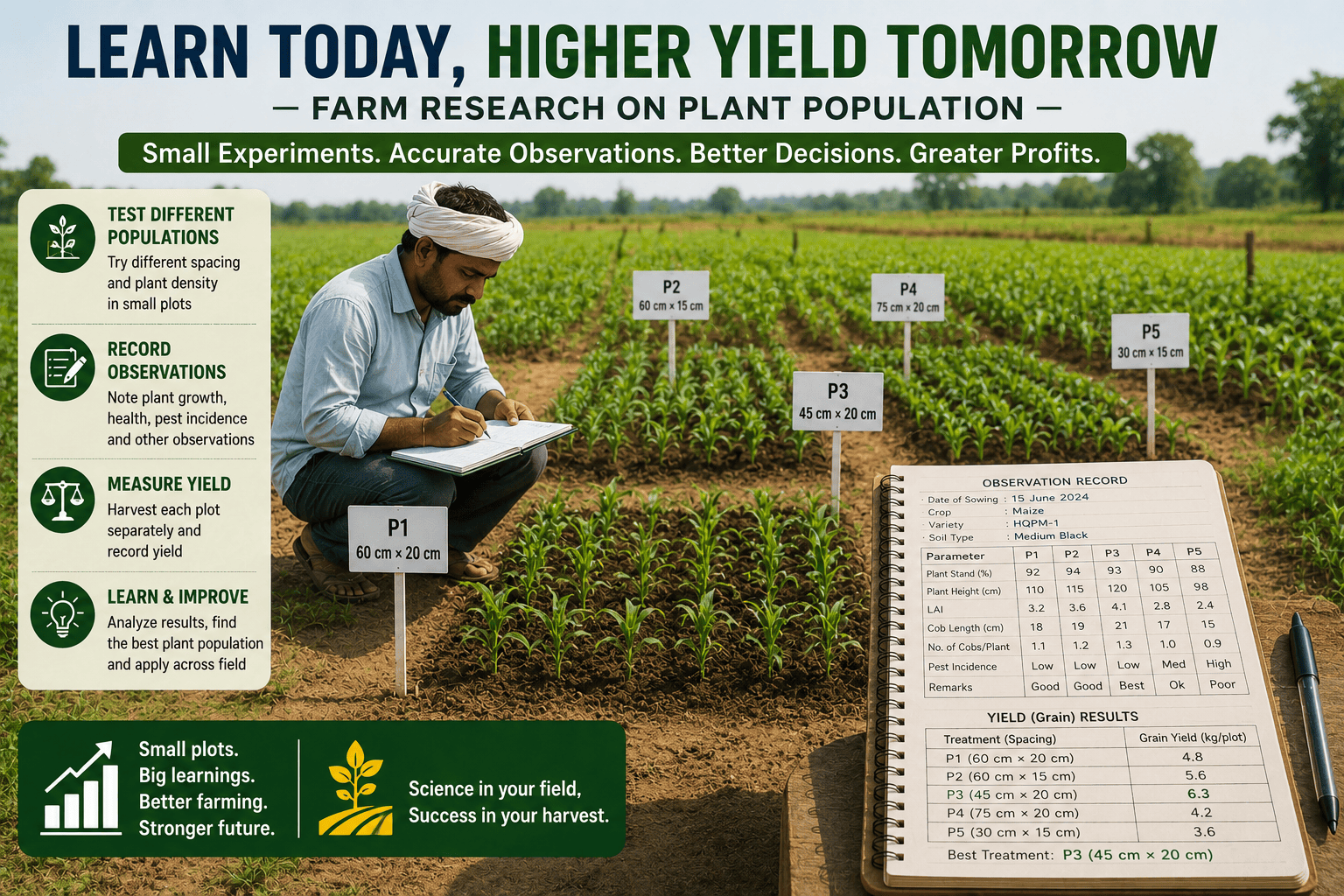
Instead, reserve a small area—about 2 to 5 percent of your field—as a demonstration plot.
For example, if you cultivate one hectare of soybean, you can reserve about 200 to 500 square metres for experimentation while managing the remaining field using your normal practice.
Now divide this demonstration area into small plots.
You might compare:
- Recommended spacing
- Slightly narrower spacing
- Slightly wider spacing
Keep everything else exactly the same.
Use the same variety, sow on the same day, apply the same fertilizers, irrigate equally and follow the same weed and pest management practices.
The only difference should be the plant population.
This allows you to understand how spacing alone influences crop performance.
Observe Like a Scientist
Many farmers observe their crops only when a problem becomes visible.
Scientific farming begins much earlier.
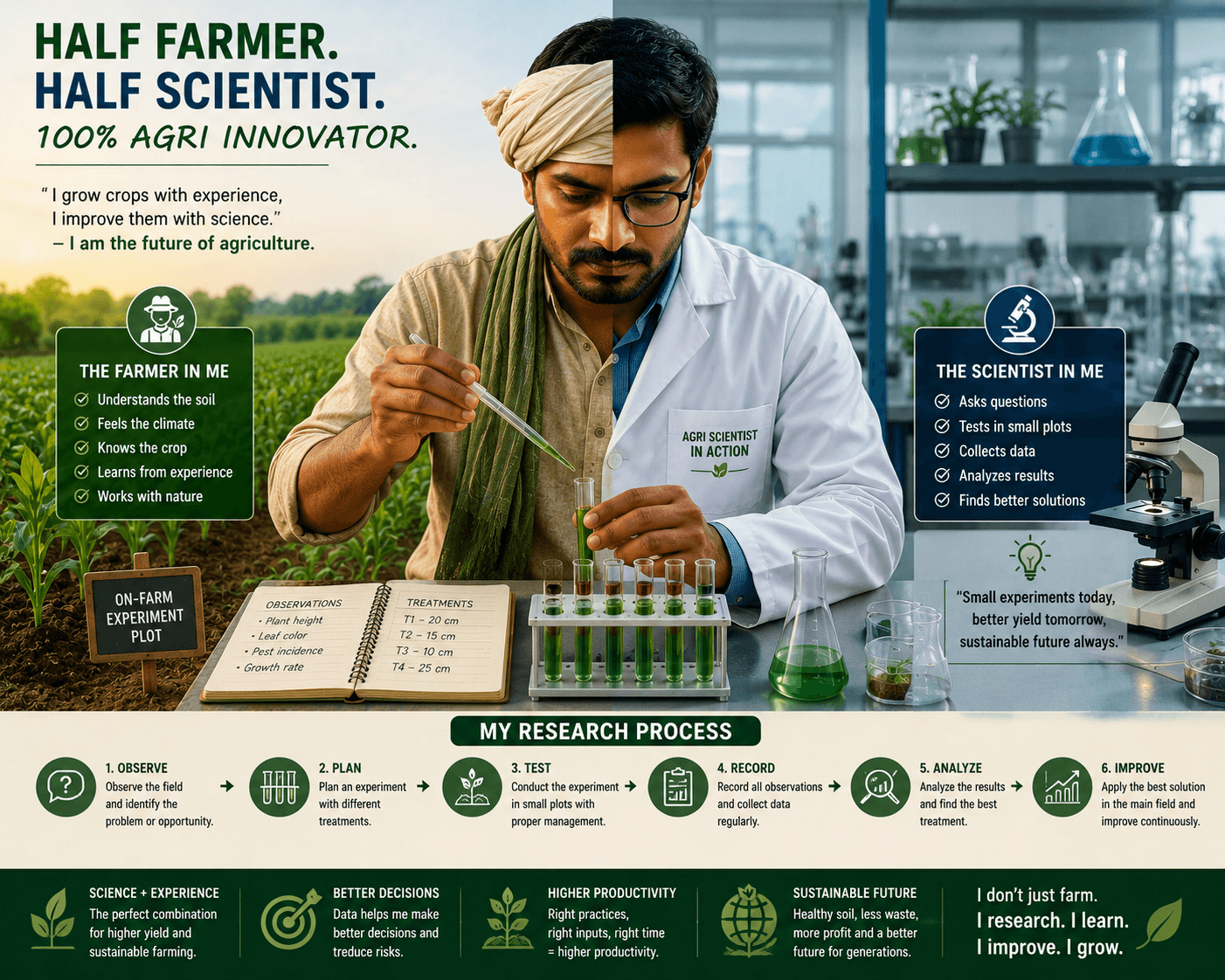
Visit your demonstration plots regularly and record simple observations throughout the season.
Ask yourself:
- Which plot germinated better?
- Which plants look healthier?
- Which spacing allowed better branching or tillering?
- Which plot had fewer weeds?
- Which plot suffered less from pests or diseases?
- Which crop matured uniformly?
Sometimes the differences are small during the early stages but become very clear by harvest.
Remember, the field teaches those who are willing to observe.
Harvest Separately, Learn Accurately
One of the biggest mistakes is harvesting all experimental plots together.
If you do that, you lose the opportunity to learn.
Harvest each plot separately.
Record:
- Grain yield
- Straw or biomass yield
- Seed used
- Cost of cultivation
- Gross income
- Net profit
You may discover something surprising.
The plot with the highest number of plants may not produce the highest profit.
Similarly, a slightly lower plant population may produce healthier plants, larger grains and better economic returns.
Let your results—not assumptions—guide your future decisions.
Keep a Farm Research Diary
Memory fades, but written records remain useful for years.
Maintain a simple notebook or digital diary where you record your observations.
You don’t need complicated tables or scientific terminology.
Just write what you see.
Over time, this diary becomes one of the most valuable books on your farm because it contains knowledge created under your own farming conditions.
After a few years, you’ll notice patterns that would otherwise go unnoticed.
You may find that one variety performs better during dry years, while another performs better under irrigation. You may discover that a slightly different plant population consistently gives better returns.
That is real scientific farming.
Learning Never Ends
Agriculture is constantly changing.
New varieties are developed.
Climate changes.
Rainfall patterns shift.
Markets fluctuate.
The practice that worked best five years ago may not always remain the best today.
Therefore, continue learning.
Continue observing.
Continue experimenting on a small scale.
Every season teaches something new to farmers who are willing to learn.
🤝 Share Your Experience with AgriTechKart
Agriculture becomes stronger when knowledge is shared.
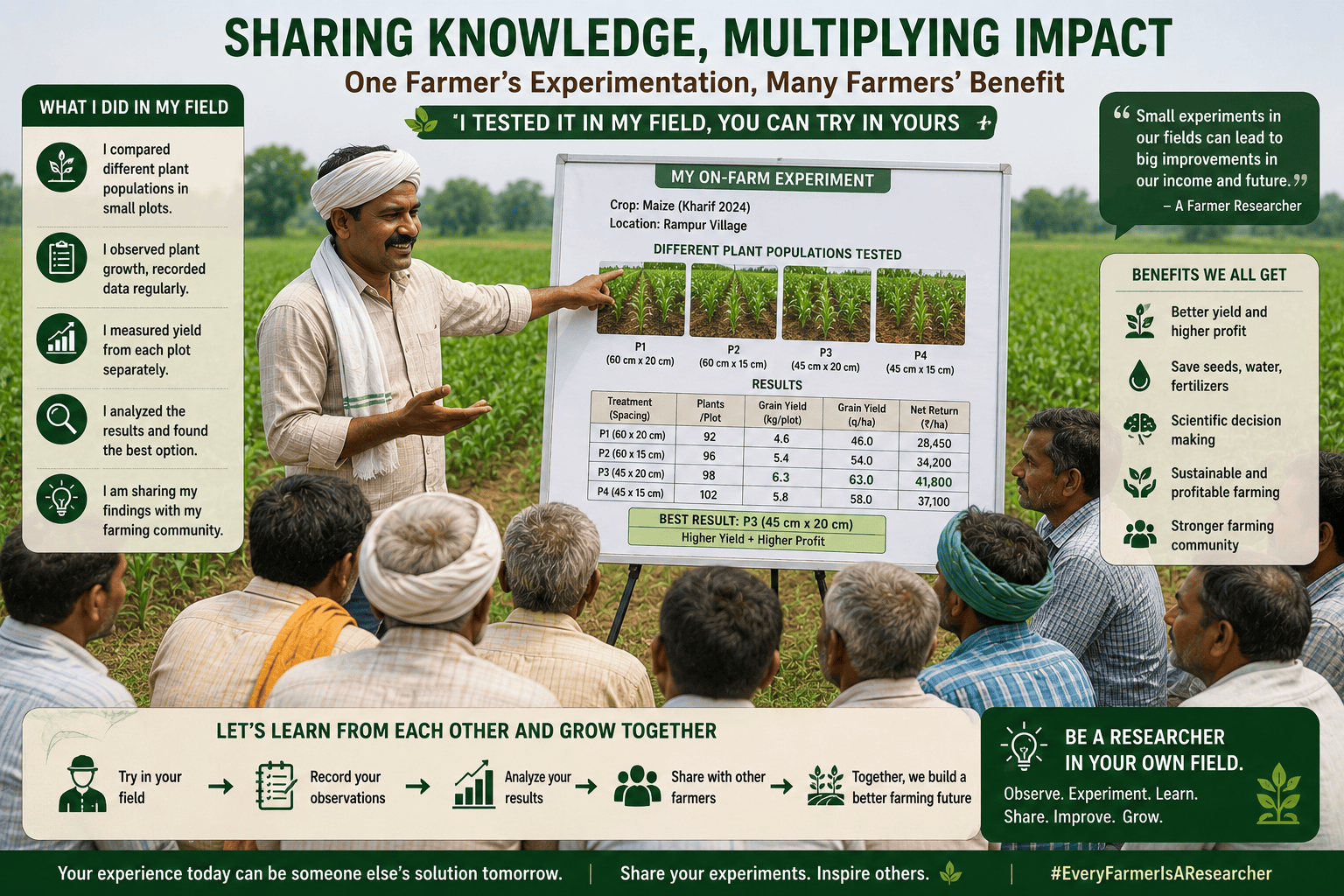
If you conduct a plant population experiment on your farm, we warmly invite you to share your experience with the AgriTechKart community.
Tell us:
- Which crop you grew.
- Your district and state.
- The different spacings you tested.
- What observations you made.
- Which spacing produced the highest yield.
- Which spacing produced the highest profit.
- What challenges you faced.
- What lessons you learned.
You can share your experiences through the comments section below or by email.
If you have photographs of your experimental plots, we’d love to see them too.
With your permission, selected farmer experiences may be featured in future AgriTechKart articles so that thousands of other farmers, students and agricultural professionals can learn from your work.
One farmer’s observation may become another farmer’s solution.
🌱 The AgriTechKart Farm Research Challenge
Before your next sowing season, take up this simple challenge.
Instead of planting your entire field at one spacing, reserve a small demonstration plot.
Compare two or three different plant populations.
Observe the crop carefully.
Record your findings.
Harvest each plot separately.
Calculate the yield and profit.
Then decide which spacing performed best under your own farming conditions.
Remember, agriculture is both a science and an art.
Science provides the principles.
Experience provides the wisdom.
The most successful farmers combine both.
Key Takeaways
Optimum plant population is much more than a mathematical calculation. It determines how efficiently your crop uses sunlight, water, nutrients and available space. Too few plants leave valuable resources unused, while too many plants create unnecessary competition.
The goal of every farmer should not be to grow the greatest number of plants but to establish the optimum plant population that produces the highest yield and maximum profit.
Understanding the science is important, but applying it in the field is even more important.
Observe your crops.
Question your assumptions.
Test new ideas on a small scale.
Keep records.
Learn from every season.
And most importantly, share your experiences so that together we can build a stronger, more knowledgeable farming community.
Together, We Grow Better Agriculture
At AgriTechKart, we believe that knowledge grows when it is shared.
Every field has a story.
Every season teaches a lesson.
Every farmer has an experience worth sharing.
Whether you are a farmer, student, agricultural officer, researcher or agribusiness professional, you are part of a larger community working towards one common goal—making agriculture more productive, profitable and sustainable.
So, the next time you walk through your field, don’t just look at your crop.
Observe it.
Question it.
Learn from it.
Because every great agricultural discovery begins with a curious mind and a simple observation.